
The Best Streets to Live On in Mayfair, Marylebone and Fitzrovia
The best streets to live on in Mayfair, Marylebone and Fitzrovia are not chosen by postcode or by price per square foot. They are chosen by landlord. Three landed estates own most of W1 between them, and what a street looks like, what is allowed to open on it and how it will look in twenty years is decided by whichever one holds the freehold.
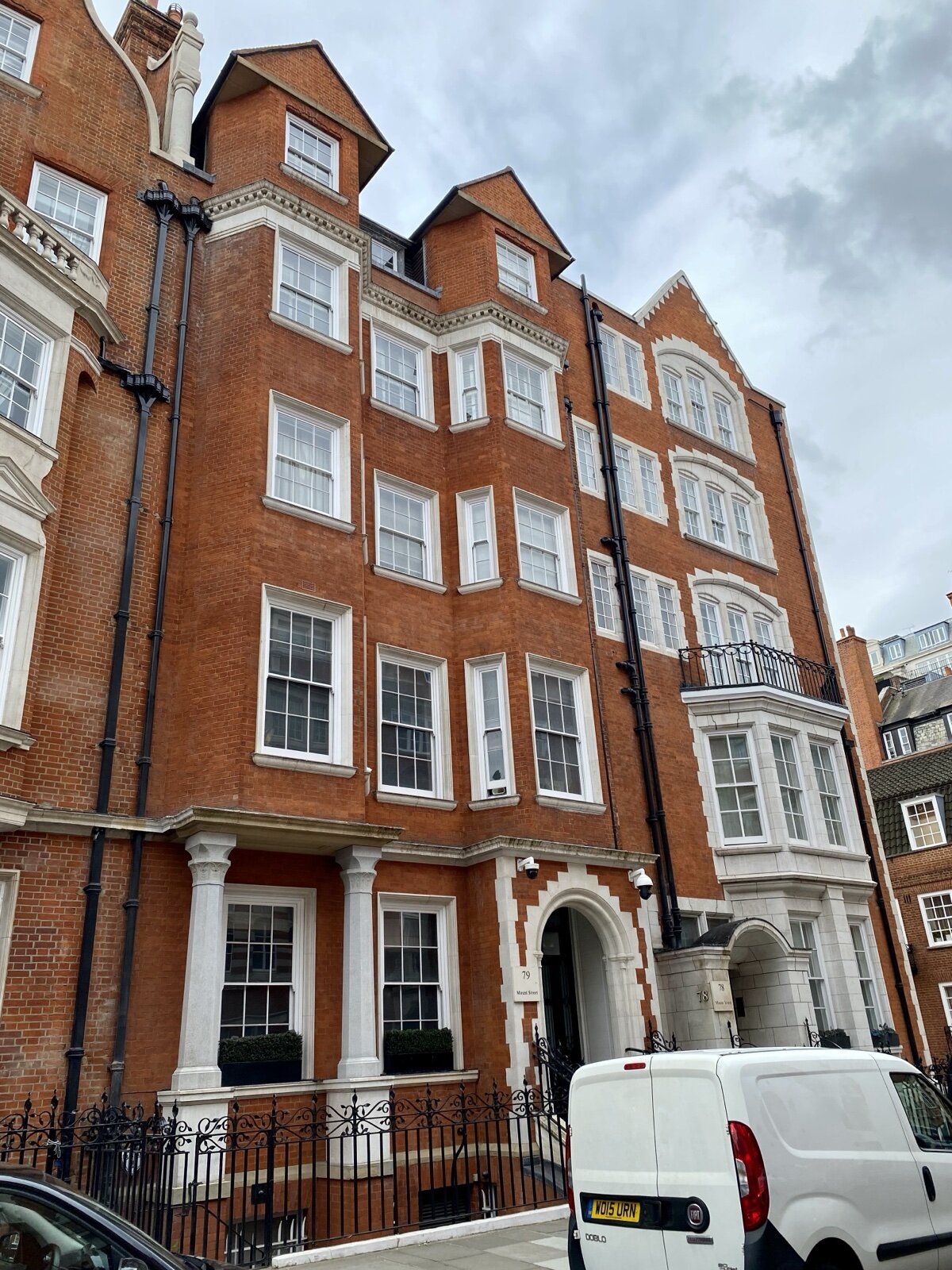
79 Mount Street, Mayfair, the red brick the Grosvenor Estate rebuilt the street in. Photo: 79 Mount Street, Mayfair, June 2023 by No Swan So Fine (CC BY-SA 4.0), via Wikimedia Commons.
Grosvenor holds around 300 acres across Mayfair and Belgravia. The Howard de Walden Estate holds 92 acres of Marylebone, including Harley Street. The Portman Estate holds 110 acres west of Marylebone High Street. Fitzrovia, the odd one out, was never consolidated in the same way, and its fragmented ownership is precisely why it still has cheap Greek restaurants next to advertising agencies. Here are the streets worth knowing in each, and what actually makes them good.
Mayfair
Mount Street, W1K
The showpiece. The 1st Duke of Westminster had the street rebuilt in the 1880s in the red brick and terracotta Queen Anne revival style it still wears, and many of those terraces are now Grade II listed, which fixes the look in place. Grosvenor directly controls 32 of the 47 retail premises, so the tenant mix is curated rather than accidental: galleries, jewellers, a handful of restaurants that have been there for decades.
Living here means living above that, which is the trade. What redeems it is Mount Street Gardens behind, created in 1889 out of the old burial ground of St George's, Hanover Square, and sheltered enough that it stays warm into October. The neo-Gothic Church of the Immaculate Conception on Farm Street backs onto it.
Brook Street, W1K
Long, straight and central, running from Hanover Square to Grosvenor Square, with the best address in London for anybody who cares about music: 23 Brook Street carries the English Heritage blue plaque to Jimi Hendrix, erected in 1997, which reads "lived here 1968-1969". Number 25 next door carries Handel's. The two houses are now a single museum, and Hendrix's bedroom was restored and opened to the public in February 2016.
It is a busier street than Mount Street and a less pretty one, but the flats above the shops are large and the location is unimprovable.
The streets north of Grosvenor Square
Upper Brook Street, Upper Grosvenor Street, Green Street, Park Street: this is where Mayfair is residential rather than commercial, and it is where people who actually live in Mayfair tend to be. Wide Georgian terraces, very little retail, and Hyde Park at the western end. If your objection to Mayfair is that it feels like a shopping district with flats above, this is the answer to it.
Marylebone
Marylebone High Street and the streets off it, W1U
The reason Marylebone keeps winning best-place-to-live lists is unglamorous: it has a working high street. Independent grocers, butchers and bakeries sit alongside the bookshops and the luxury names, which is genuinely rare in central London. That mix was engineered. From the 1990s the Howard de Walden Estate set out to reposition the area, bringing in The Conran Shop and a Waitrose among others, and it has held the line on the tenant mix since.
The streets running off it, Marylebone Lane, New Cavendish Street, Weymouth Street, give you the amenity without the footfall.
Chiltern Street, W1U
A short street that punches above its size, dominated by the Grade II listed 1889 fire station at its centre. That building was converted into a hotel and restaurant, the Chiltern Firehouse, which opened in 2014 and pulled the whole street upmarket. Condé Nast Traveller has called Chiltern Street London's coolest street.
One thing to know before you get excited: the Firehouse was badly damaged by fire on 14 February 2025. The London Fire Brigade sent 125 firefighters and 20 engines, and the blaze destroyed the third floor and the roof. The forecast reopening is April 2027. The street is quieter than it was, which depending on your temperament is either a loss or the point.
Montagu Square and Bryanston Square, W1H
Portman Estate territory, west of the High Street, and the best garden squares in Marylebone. Montagu Square has the rock history: 34 Montagu Square was Ringo Starr's flat, later tenanted by Jimi Hendrix, who wrote "The Wind Cries Mary" there, and then by John Lennon and Yoko Ono. The English Heritage blue plaque to Lennon was unveiled by Yoko Ono on 23 October 2010 and reads "lived here in 1968".
Practically, these squares give you what Mayfair mostly cannot: a private garden, a quiet street, and a five minute walk to Marble Arch.
Fitzrovia
Fitzroy Square, W1T
The single best address in Fitzrovia and one of the most complete Georgian squares in London. Robert Adam designed the east and south sides, with leases granted in 1792 and the work finished in 1798 by his brothers James and William. The north and west sides followed in 1827 to 1829 and 1832 to 1835. Numbers 1, 1A, 2 to 8 and 33 to 40 are Grade I listed, the highest grade there is.
What makes it liveable rather than merely handsome is that it was largely pedestrianised in the 1970s, to a scheme by the landscape architect Geoffrey Jellicoe, and resurfaced with restricted vehicle access in 2008. It is one of the few central London squares where you can hear birds.
Number 29 is the literary address: George Bernard Shaw lived there from 1887 until his marriage in 1898, and Virginia Woolf from 1907 to 1911. Woolf's blue plaque went up in 1974.
Charlotte Street and Percy Street, W1T
Fitzrovia's restaurant spine and the street that gives the area its character. Charlotte Street is loud in the evenings and worth living on only if that is what you want; Percy Street, running off it towards Tottenham Court Road, is the quieter version with the same access. Neither is grand. Both are more interesting than most of what W1 offers at the price.
How to choose between them
- You want the best-looking street and do not mind shops: Mount Street.
- You want Mayfair without the retail: Upper Brook Street, Green Street, Park Street.
- You want to be able to buy a chicken and a book on the same walk: Marylebone High Street and the lanes off it.
- You want a garden square and quiet: Montagu Square or Bryanston Square.
- You want architecture and almost no traffic: Fitzroy Square.
- You want life on the doorstep and a lower entry price: Percy Street.
More on living here: living in W1, Mayfair versus Marylebone, what a W1 flat costs to buy and what it costs to rent. The area guides for Mayfair, Marylebone and Fitzrovia cover what is on each doorstep, and W1 London has the rest.
Frequently Asked Questions
Which is the best street to live on in Mayfair?
Mount Street is the one most people name, and for a reason: the Grosvenor Estate rebuilt it in the 1880s in red brick and terracotta, many of those terraces are Grade II listed, and the Estate still directly controls 32 of the street's 47 retail units, which is why the shops stay consistent. If you want quiet rather than shopfronts, the residential Mayfair streets running north from Grosvenor Square are the better answer.
Who owns the freeholds in W1?
Mostly three landed estates. Grosvenor holds around 300 acres across Mayfair and Belgravia. The Howard de Walden Estate holds 92 acres of Marylebone, including Harley Street. The Portman Estate holds 110 acres to the west of Marylebone High Street. Fitzrovia is the exception, with far more fragmented ownership, which is exactly why it looks and feels different.
Is Marylebone a good place to live?
It is consistently the most liveable part of W1, because it has an actual high street. Marylebone High Street carries independent grocers, butchers, bakeries and bookshops alongside the luxury names, which is rare in central London. The Howard de Walden Estate repositioned the area deliberately from the 1990s, and the mix has held.
What is the quietest part of W1?
Fitzroy Square. It was largely pedestrianised in the 1970s to a design by Geoffrey Jellicoe and resurfaced with restricted vehicle access in 2008, so it is one of the few central London squares where traffic is not the dominant sound. The Portman Estate garden squares, Montagu Square and Bryanston Square, are the Marylebone equivalent.
Which W1 streets have blue plaques worth knowing?
23 Brook Street in Mayfair carries the English Heritage plaque to Jimi Hendrix, erected in 1997, next door to Handel at number 25, and the two are now one museum. 34 Montagu Square in Marylebone has the plaque to John Lennon, unveiled by Yoko Ono in 2010. 29 Fitzroy Square housed George Bernard Shaw and then Virginia Woolf, whose plaque went up in 1974.
Should I buy freehold or leasehold in W1?
In most of Mayfair and Marylebone the question does not arise, because the estates sell long leases and keep the freehold. What matters instead is the length of the lease, the ground rent and the estate's rules on alterations, all of which are checked by your solicitor before exchange, not after. Our guide to buying in prime central London goes through the process.
Sources
- English Heritage: Jimi Hendrix blue plaque, 23 Brook Street, for the 1997 erection date and the inscription
- Grosvenor: Mount Street, for the Estate's holding and the street's retail mix
Checked on 14 September 2026. Listing grades and plaque details are from Historic England and English Heritage records; the Chiltern Firehouse reopening date is the forecast published after the February 2025 fire and may move.