
Home › Culture & history
Blue Plaques in Mayfair and Fitzrovia: Who Lived Where, and at Which Number
The blue plaques in Mayfair and Fitzrovia are the cheapest thing to do in W1 and among the most rewarding, because in this postcode the buildings are still standing. A plaque only goes up on the actual surviving house, which is why the concentration here is so high and why an afternoon on foot takes you past a baroque composer, a rock guitarist, two prime ministers, a Bloomsbury novelist and the man who made surgery survivable. Below is the list with exact addresses, in the order you would sensibly walk them.
How the scheme works, and what the plaque is telling you
London's blue plaque scheme started in 1866 and is thought to be the oldest of its kind in the world. More than 1,000 plaques are now spread across the capital, and English Heritage runs the scheme today. Two details make the plaques more interesting once you know them.
- The erecting body is written on the plaque. London County Council, Greater London Council or English Heritage. That tells you roughly when it went up, which is often a story in itself: Florence Nightingale was commemorated in the 1950s, Jimi Hendrix decades later.
- The building has to survive. A plaque marks a house that is still there, not a site. That rule is the reason Mayfair and Fitzrovia are so thickly plaqued and the reason large parts of London that were bombed or redeveloped are nearly bare.
One practical note before you set off: Fitzrovia is split between two boroughs. The Fitzroy Square and Percy Street plaques are in Camden, the Mayfair ones in Westminster, and both sit inside the W1 postcode.
Mayfair
George Frideric Handel, 25 Brook Street
Handel lived and composed at 25 Brook Street. The house is now part of Handel Hendrix House, the museum that occupies both this building and its neighbour, and which has reconstructed the flat next door as it was in the 1960s.
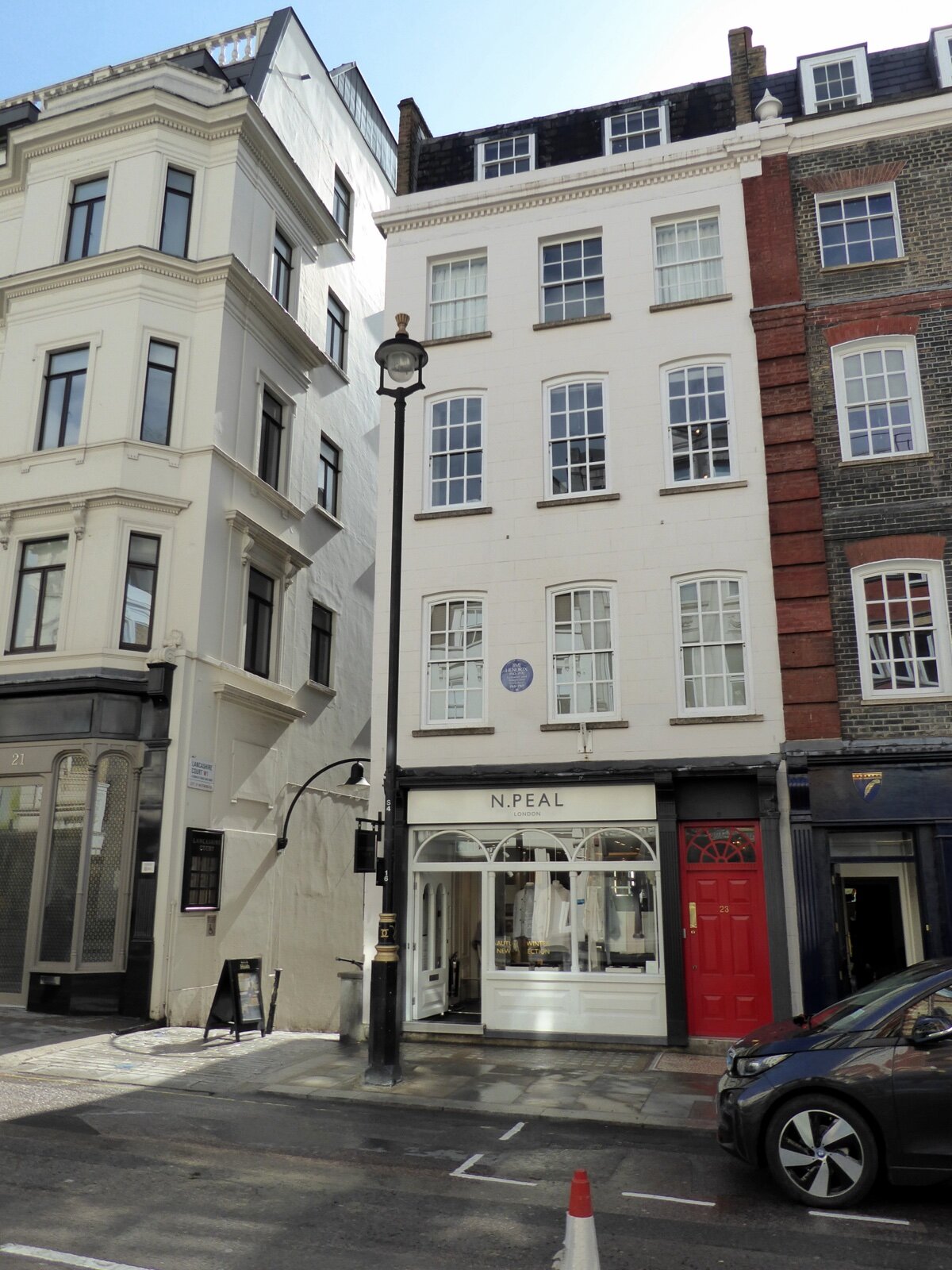
Jimi Hendrix, 23 Brook Street
The best pairing in London: Hendrix's plaque is on the house immediately next door to Handel's. Asked about living beside a baroque composer, Hendrix is reported to have said he had not heard much of the fellow's stuff. Both plaques are visible from the pavement and both houses form the museum, which is worth the ticket if you want to see inside rather than just look up.
Florence Nightingale, 10 South Street
The London County Council put this one up in 1955. Nightingale spent the long second half of her life here, largely housebound, writing the reports and statistical work that changed hospital administration far more than the Crimean legend suggests.
Robert Clive, 45 Berkeley Square
Erected by the London County Council in 1953 to Robert Clive, Baron Clive of Plassey, the soldier and administrator known as Clive of India. It is the most contested plaque in Mayfair, and the honest reading is that the scheme records who lived where rather than passing judgment on them.
Beau Brummell, 4 Chesterfield Street
Put up by the Greater London Council in 1984 to the man who invented modern men's dress. Chesterfield Street is one of the least altered streets in Mayfair, so this is the plaque where the setting most resembles what the subject actually saw. Our Mayfair guide covers what else is worth a detour nearby.
A short walk north: Marylebone
John Lennon, 34 Montagu Square
English Heritage erected this in 2010 and Yoko Ono unveiled it. Lennon lived here with Ono in 1968, in a flat that also housed Ringo Starr and, at another point, Jimi Hendrix, which makes 34 Montagu Square one of the most densely occupied addresses in British popular music. See our Marylebone guide for the surrounding streets.
Fitzrovia, and the remarkable case of Fitzroy Square
Five plaques on one Georgian square is unusual even by London standards.
Virginia Woolf and George Bernard Shaw, 29 Fitzroy Square
Woolf's plaque, erected by the Greater London Council in 1974, reads: Virginia Stephen (Virginia Woolf) 1882 to 1941, Novelist and Critic, lived here 1907 to 1911. She took a five-year lease on the house with her brother Adrian in August 1907. Shaw had been a tenant of number 29 before her, and his plaque sits above hers on the same frontage. It is the only address in W1 where you can read two literary plaques without moving your feet.
Roger Fry, 33 Fitzroy Square
Erected in 2010 to the artist and critic. Number 33 housed Fry's Omega Workshops, which produced avant-garde furniture and decorative art from 1913 to 1919 and pulled much of Bloomsbury into the square.
Robert Gascoyne-Cecil, 3rd Marquess of Salisbury, 21 Fitzroy Square
A prime minister's plaque, erected in 1965, on a square better known for artists and writers.
Sir Charles Eastlake, 7 Fitzroy Square
Erected in 1985 to the painter who became the first director of the National Gallery.
August Wilhelm Hofmann, 9 Fitzroy Square
Also 1985, to the professor of chemistry whose work in London seeded the British synthetic dye industry. Two plaques of the same vintage two doors apart, on a square that now reads mostly as medical consulting rooms.
Charles Laughton, 15 Percy Street, and Coventry Patmore, 14 Percy Street
Next-door neighbours separated by a century: the poet Coventry Patmore commemorated in 1960 at number 14, and the actor Charles Laughton in 1992 at number 15. Percy Street is two minutes from Tottenham Court Road and almost nobody looks up.
Joseph Lister, 52 Maple Street
One of the newest plaques in the area, erected in 2024 to the pioneer of antiseptic surgery. Worth including in a walk precisely because it is new: the scheme is still running, and the list is not closed.
A walkable route
Start at Bond Street station. Brook Street for Handel and Hendrix, south to Chesterfield Street for Brummell, east to Berkeley Square for Clive, then South Street for Nightingale. That is Mayfair in about forty minutes at a slow pace. For the second half, walk or take the Elizabeth line to Tottenham Court Road, then Percy Street, Maple Street and Fitzroy Square, which are close enough together to do in half an hour. Montagu Square is the outlier and fits better onto a Marylebone walk than either of these.
Everything above is free, outdoors and available at any hour, which puts it on the short list in our guide to free things to do in W1. If you want the same kind of walking history a few streets south, our piece on the hidden history of Soho covers ground that the plaque scheme largely misses, and the Fitzrovia guide has the pubs and restaurants to finish in. The rest of the postcode is at The W1 London.
What the plaques do not tell you
Three things worth holding in mind as you walk. The scheme commemorates individuals, so the Omega Workshops appear only through Roger Fry and the Bloomsbury group only through Woolf. It has historically skewed heavily towards men, which English Heritage has been working to correct with recent nominations. And it records residence, not achievement in that building: Handel wrote Messiah at 25 Brook Street, but Nightingale's plaque marks the house she retreated to, not a hospital she reformed. The plaque is a starting point for a question, not an answer.
Frequently asked questions
Where are Handel's and Hendrix's blue plaques?
Next door to each other on Brook Street in Mayfair: Handel at number 25 and Jimi Hendrix at number 23. Both houses now form Handel Hendrix House, a museum that has reconstructed Hendrix's 1960s flat, and both plaques are visible from the pavement for free.
How many blue plaques are there in London?
More than 1,000 across the capital. The scheme began in 1866, is thought to be the oldest of its kind in the world, and is run today by English Heritage.
Which square in W1 has the most blue plaques?
Fitzroy Square, with plaques to Virginia Woolf and George Bernard Shaw at number 29, Roger Fry at 33, the 3rd Marquess of Salisbury at 21, Sir Charles Eastlake at 7 and August Wilhelm Hofmann at 9.
Do you have to pay to see blue plaques?
No. Every plaque is fixed to the outside of a building and visible from the street at any time. You only pay if you want to go inside somewhere like Handel Hendrix House.
What do the initials on a blue plaque mean?
They name the body that erected it: London County Council, then Greater London Council, then English Heritage. They are the quickest way to date a plaque, which is often a story in itself about when a person came to be considered worth commemorating.
Can a blue plaque be put up if the building has gone?
No. Under the English Heritage scheme the building the person lived in has to survive. That rule is why Mayfair and Fitzrovia, which kept most of their Georgian and Victorian housing, carry so many more plaques than areas that were rebuilt.
Sources
- English Heritage, blue plaques, for the scheme's history and scale.
- Virginia Woolf, Beau Brummell and John Lennon plaque records, for inscriptions, addresses and dates.