
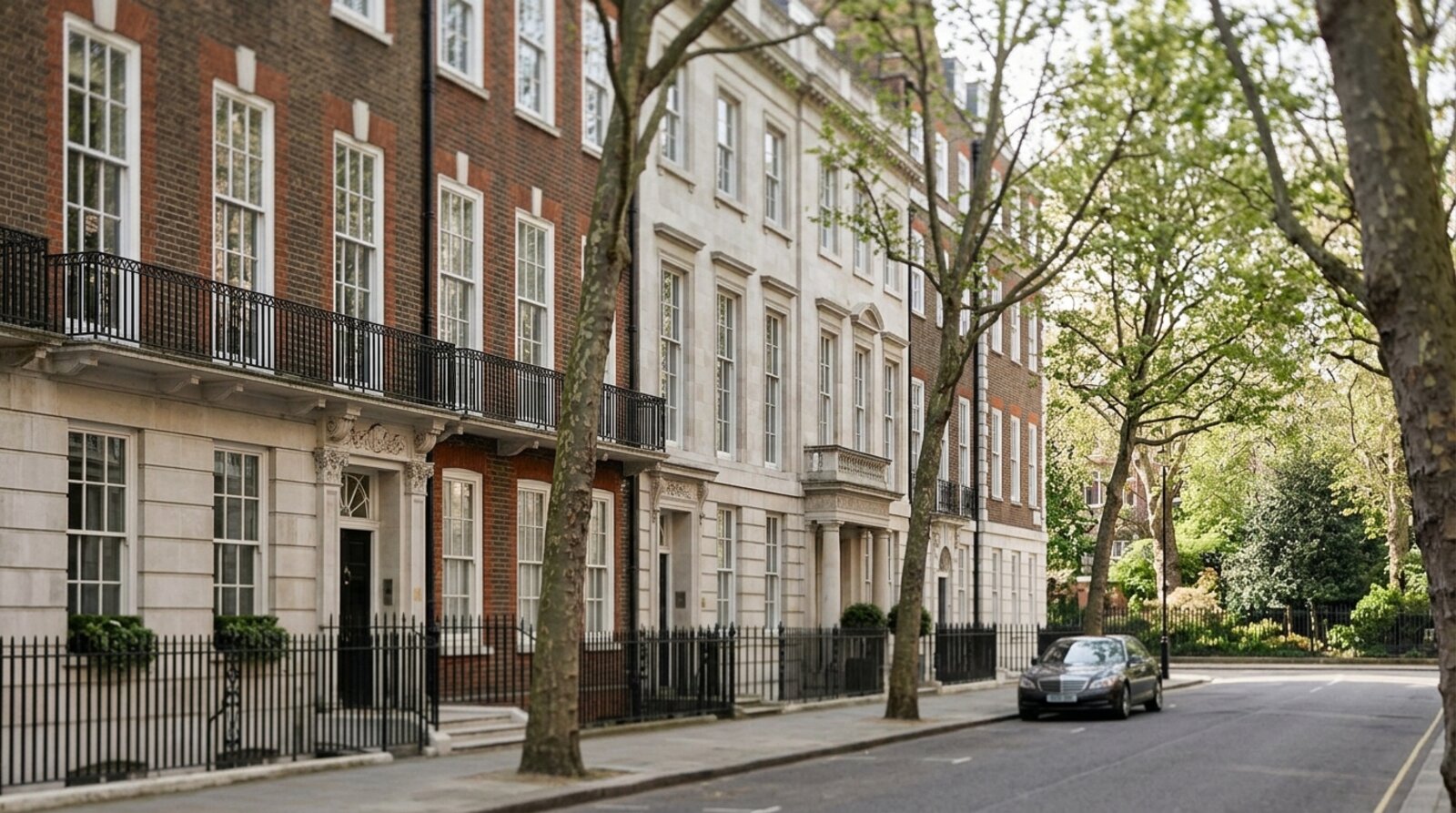
What it really costs to buy in Mayfair and wider W1, from price per square foot to leasehold reality and stamp duty
Start the GuideMayfair is where the UK property market reaches its ceiling. Inside the streets bounded by Hyde Park, Oxford Street, Regent Street and Piccadilly, buyers are paying among the highest prices per square foot in the country, and a single purchase can carry a stamp duty bill larger than the price of a house elsewhere. Buying here is a different exercise from buying almost anywhere else, and the detail matters at every stage.
This guide is written for the person who has decided they want to buy in Mayfair or the wider W1 postcode and now needs the practical numbers: what properties cost by type and street, how the buying process runs, why so much of the area is leasehold, what service charges and ground rent look like, and how much stamp duty you will actually pay as a main-home buyer, a second-home buyer or an overseas buyer.
For the neighbourhood itself, its history and its shops and restaurants, read our full Mayfair guide. This page concentrates on one thing: the residential transaction.
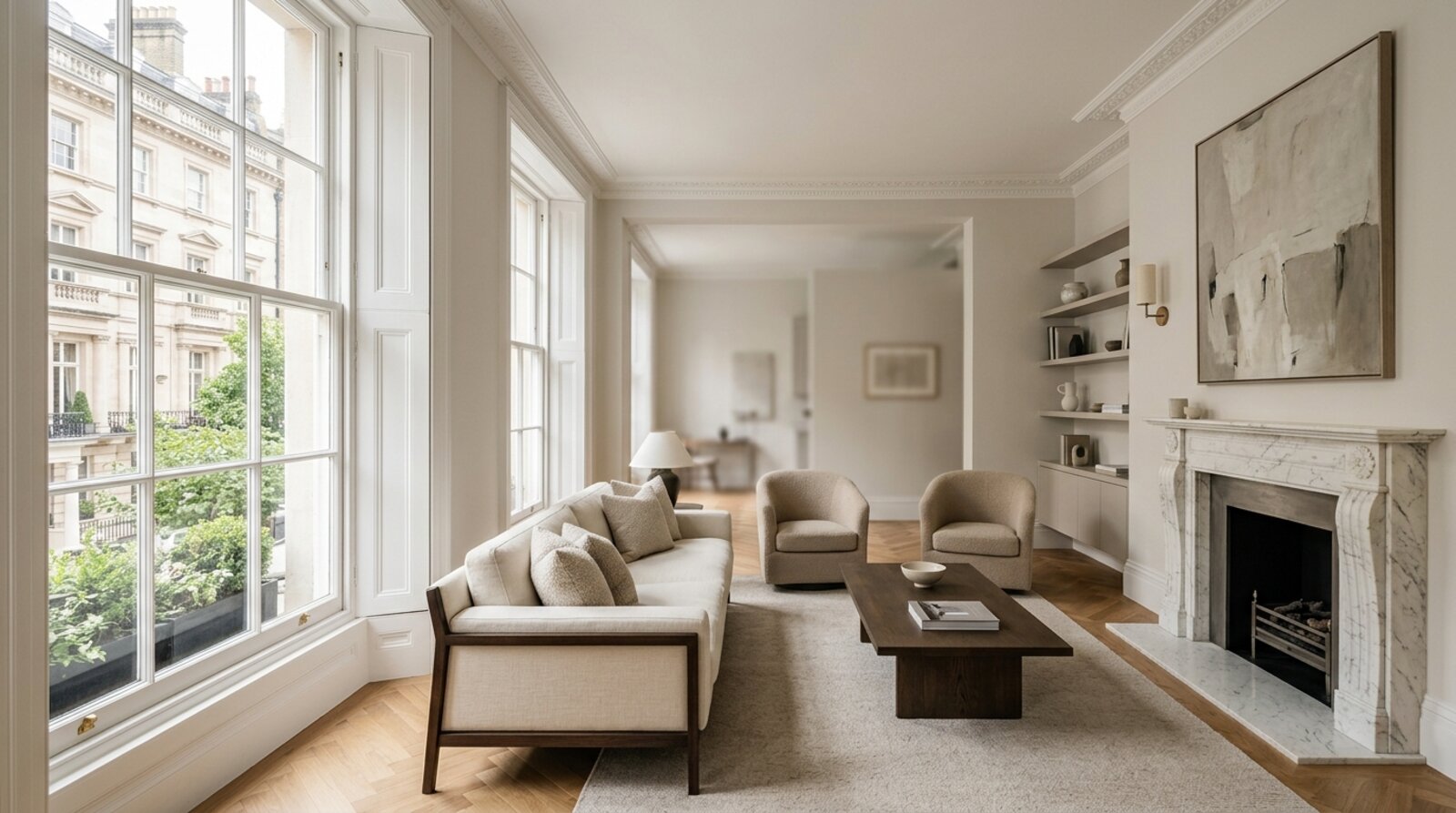
Quality resale flats in Mayfair are trading at roughly 4,000 to 6,000 pounds per square foot, with prime new developments around Grosvenor Square pricing at 8,000 to 10,000 pounds and above. Indicative averages put a one-bedroom flat near 1.49 million pounds, a two-bedroom near 2.31 million pounds and a three-bedroom near 4.49 million pounds. Best-in-class houses on the garden squares run well into the tens of millions. You can model the tax on any figure using the government's free Stamp Duty Land Tax calculator.
Prices by property type and the role of price per square foot
In prime central London, headline asking prices tell you less than the price per square foot, because two flats with the same number of bedrooms can differ hugely in size and lateral space. As a working range for early 2026, plan around 4,000 to 6,000 pounds per square foot for good resale stock, rising sharply for new-build and trophy lateral apartments.
That means a generous 1,500 square foot two-bedroom flat can sit anywhere from roughly 6 million pounds upward depending on the building, floor, light and outlook. Ask any agent for the price per square foot achieved on recent comparable sales in the same block before you commit.
Treat these as starting points, not ceilings. Floor, aspect, lease length, building reputation and whether the flat has lift access or outdoor space all move the price within a postcode.
This is the part of a Mayfair purchase that catches buyers from outside prime central London by surprise. Most flats here are leasehold, and a large share of the area sits on the Grosvenor Estate, owned by the Grosvenor family for roughly three centuries, which retains the freehold and grants long leases over the land it developed around Grosvenor Square in the 1720s.
A leasehold owner holds the flat for a fixed term of years, pays ground rent and service charges, and answers to a freeholder or its managing agent for major works and consents. Lease length matters: a long lease of well over 100 years is comfortable, while anything under about 80 years can be expensive to extend and can deter mortgage lenders. Always confirm the unexpired term and the cost of any extension before you offer.
Some period mansion blocks are sold as share of freehold, where the leaseholders jointly own the building through a company and grant themselves long leases. This usually gives owners more control over service charges and major works, and removes the squeeze of a shortening lease. It is generally seen as the most attractive ownership structure for a flat, so it tends to carry a premium.
Whole houses are more often freehold, but many still sit on estate land and carry covenants that govern alterations, use and even shopfronts. On the Grosvenor Estate this estate management is part of why frontages stay so consistent, and your solicitor should report on any restrictions that affect your plans.
Service charges in a prime Mayfair block fund the staff, security, lifts, maintenance and reserves that the address depends on, and in a fully serviced building they can run to many thousands of pounds a year. Ask for the last three years of accounts, the current budget and the reserve fund balance, and check for any planned major works such as roof, lift or facade projects that could trigger a large one-off bill.
Leaseholders also pay ground rent to the freeholder. Watch for review clauses that increase the rent over time, since onerous escalating ground rents can affect both value and mortgageability. Share of freehold flats usually carry only a token ground rent or none at all.
Beyond the purchase price, budget for the transaction and holding costs that come with a prime W1 home:
Total these annual figures alongside your mortgage before you commit, so you know the true running cost of holding a home in the postcode rather than just the purchase price.
The tax that often surprises first-time prime buyers most
Stamp Duty Land Tax is charged in bands, so you pay a different rate on each slice of the price rather than one rate on the whole figure. The current residential bands for a single main home are nil up to 125,000 pounds, 2 per cent from 125,001 to 250,000 pounds, 5 per cent from 250,001 to 925,000 pounds, 10 per cent from 925,001 to 1.5 million pounds, and 12 per cent on everything above 1.5 million pounds.
On a 4 million pound flat bought as your only home, that works out at about 393,750 pounds in stamp duty. Two surcharges can push it much higher.
If the purchase means you own more than one residential property, a 5 per cent surcharge is added across the whole price. On a 4 million pound purchase that adds 200,000 pounds, taking the bill to about 593,750 pounds.
Buyers who are not UK resident for these rules, broadly meaning fewer than 183 days in the UK in the relevant 12 months, pay a further 2 per cent on top. On a 4 million pound purchase that is another 80,000 pounds. A non-resident buying an additional property therefore carries both surcharges, lifting the tax on a 4 million pound flat to roughly 673,750 pounds.
These figures move with the price, so run your own numbers. You can confirm the bands and reliefs on the government's official Stamp Duty Land Tax guidance before you commit.
On a 4 million pound Mayfair flat: a main-home buyer pays about 393,750 pounds; a buyer of an additional property pays about 593,750 pounds with the 5 per cent surcharge; and a non-resident buying an additional property pays roughly 673,750 pounds once the 2 per cent non-resident surcharge is added. Always model your exact figure before offering.
Mayfair's most prized residential addresses cluster around its garden squares and its quieter, lower-built streets:
Floor, light and outlook can matter as much as the street name, so judge each flat on its own merits as well as its postcode.
Much of Mayfair sits within the Grosvenor Estate, which still owns and manages a large slice of the area. Buying on an estate means consistent frontages, careful long-term management and clear processes for consents, but it also means covenants and, for leaseholders, a single freeholder you will deal with for years.
A short walk north, Marylebone is shaped by the Howard de Walden Estate, which manages around 92 acres of largely Georgian property including Harley Street. The estate behind a home affects its lease terms, its alteration rights and its long-run value, so make it one of your first questions. To compare the area, read our Marylebone guide.
Buying in Mayfair follows the standard England and Wales process, but the value, the leasehold detail and the estate consents make every step heavier. A few points keep a purchase on track.
Prime central London is competitive at the top, and sellers and agents take proof of funds seriously. Have your finance arranged or your cash confirmed, and instruct a solicitor who works in prime central London before you offer, not after.
Once an offer is agreed, the legal work covers searches, enquiries on the lease and service charges, the survey and any mortgage. A clean cash purchase can complete in roughly six to ten weeks, while a leasehold purchase or one with a mortgage often runs to twelve weeks or more once estate consents and detailed enquiries are factored in.
Allow a realistic buffer and keep your solicitor and agent talking to each other throughout. To find advisers and estate agents in the area, see our W1 business directory.
How the three central W1 districts compare for buyers
Mayfair is the most expensive and the most formal of the three, with the grandest blocks, the strongest estate management and the highest prices per square foot. It suits a buyer who wants a landmark address and the lateral space and security that come with prime blocks.
Marylebone, much of it on the Howard de Walden Estate, trades some of Mayfair's grandeur for a calmer, more residential character and often more space for the money. It appeals to buyers who want a real neighbourhood while staying inside W1. Read our Marylebone guide for the detail.
Soho is the smallest in scale and the most urban in feel, with flats above one of London's busiest dining and nightlife districts. It rewards buyers who want energy and a central pied-a-terre rather than family-sized space. See our Soho guide for more.
Buy in Mayfair for the grandest blocks, the strongest estate management and a landmark address. Choose Marylebone for more space and a village feel within W1. Pick Soho for a compact, central base in the heart of the action. All three share the same postcode and central location.
In early 2026, quality resale flats trade at roughly 4,000 to 6,000 pounds per square foot, with prime new developments around Grosvenor Square reaching 8,000 to 10,000 pounds and above. A one-bedroom flat starts near 1.49 million pounds, a two-bedroom near 2.31 million pounds and a three-bedroom near 4.49 million pounds, while houses on the best garden squares run into the tens of millions.
Most flats are leasehold, and a large share of the area sits within the Grosvenor Estate, which retains the freehold and grants long leases. Some period mansion blocks are sold as share of freehold, where the owners jointly hold the building. Whole houses are more often freehold, though many still sit on estate land with covenants attached.
The tax is tiered, with 12 per cent charged on the part of the price above 1.5 million pounds. On a 4 million pound main home a standard buyer pays about 393,750 pounds. An additional-property buyer adds a 5 per cent surcharge across the whole price, and a non-UK resident adds a further 2 per cent, so both together can lift the bill by 280,000 pounds on a 4 million pound flat.
Mount Street, the garden squares of Grosvenor Square and Berkeley Square, and the quieter addresses around South Audley Street and Charles Street are among the most sought after. Mount Street pairs period mansion flats with the area's strongest retail, while the garden squares offer the largest lateral apartments and houses.
A clean cash purchase can complete in around six to ten weeks once an offer is agreed, while a leasehold purchase or one with a mortgage often runs to twelve weeks or more. Long leasehold titles, estate consents and detailed service charge enquiries all add time, so build in a buffer and instruct a prime central London solicitor before you offer.
Mayfair sits at the top of the W1 market for grandeur, price and estate management, and suits buyers who want a landmark address. Marylebone, much of it on the Howard de Walden Estate, offers a calmer village feel and often more space for the money. Both share the W1 postcode and a central location.
The full guide to London's most exclusive neighbourhood and its luxury living
Explore Mayfair →The village feel, space and refined living of Marylebone
Explore Marylebone →Find estate agents, solicitors and the W1 professionals you need
View the Directory →Return to our W1 London homepage for an overview of all districts, or contact us at advertise@thew1london.com for business enquiries.