
Hidden Gems in W1: Nine Quiet Corners of Central London
The best hidden gems in central London are not hidden at all. They sit a street or two back from Oxford Street, Bond Street and Piccadilly, in plain sight of millions of people who walk straight past. In W1 that means a garden on the roof of an Edwardian electricity substation, a free museum of the science that lit London, a Georgian market village where Mayfair got its name, and a church hailed as its architect's masterpiece. None needs a ticket, and most are within fifteen minutes' walk of each other.
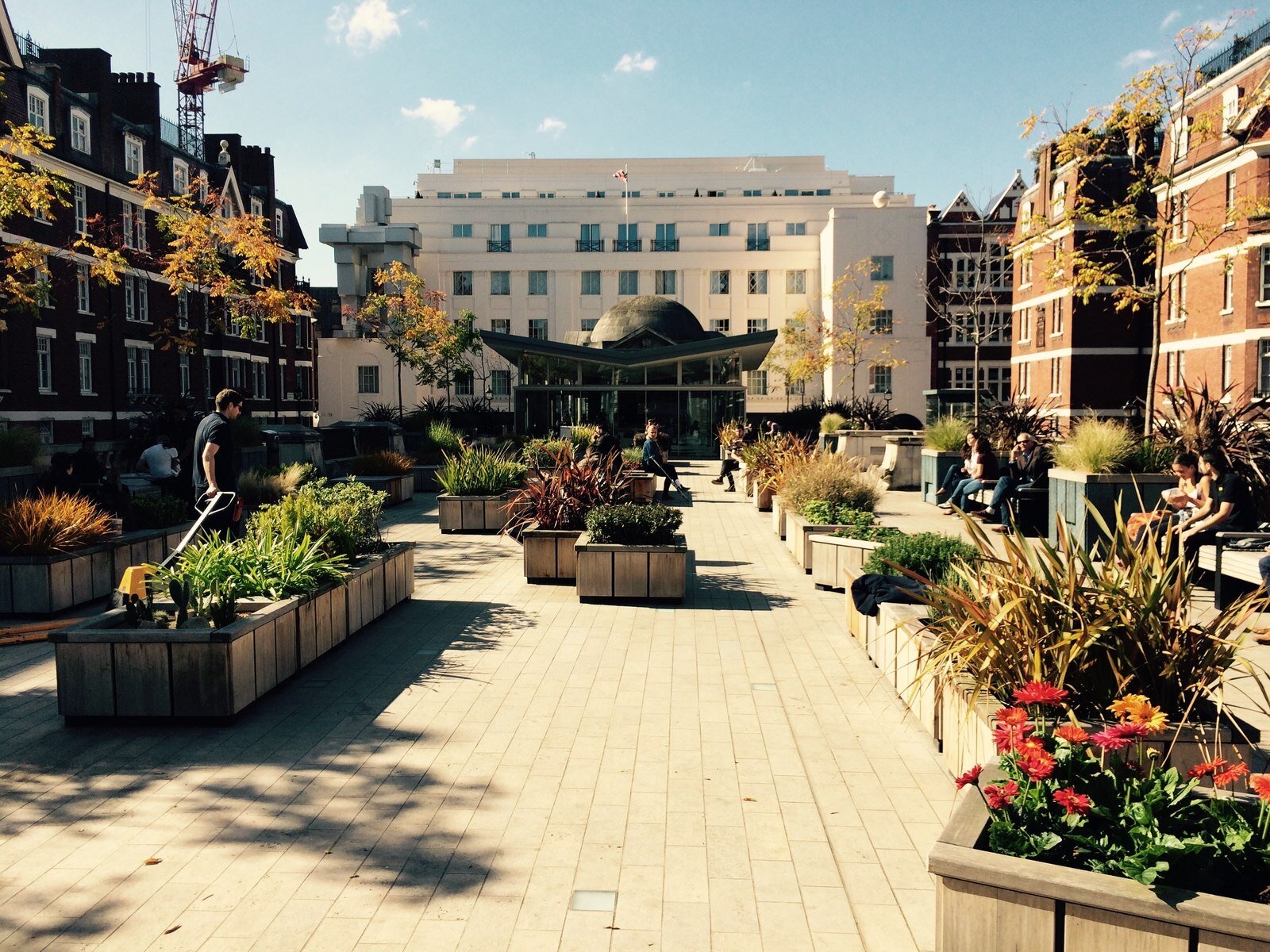
Brown Hart Gardens, Mayfair. Photo: Brown Hart Gardens, London by James Wood (CC BY-SA 2.0), via Wikimedia Commons
Mayfair
1. Brown Hart Gardens
Off Duke Street, a flight of steps leads up to a paved Italian garden with trees in tubs and a domed pavilion. You are standing on the roof of the Duke Street electricity substation, completed in 1905 to a Baroque design in Portland stone by Charles Stanley Peach. The substation replaced a communal garden for the working-class flats in Brown Street and Hart Street, and the Duke of Westminster insisted on a garden on top to compensate residents. It is one of the most improbable public spaces in London, and a short walk from Bond Street station.
2. Mount Street Gardens
Walk down Mount Street and turn through the gate by South Audley Street, and the traffic noise drops away. The gardens were laid out in 1889 on a former burial ground of St George's, Hanover Square, and take their name from the Mount Field, the site of an English Civil War fortification. The fountain, two cisterns, the gate piers with lamps and the two K2 telephone kiosks are all listed Grade II.
3. Farm Street Church
From the gardens, a side door leads into the Church of the Immaculate Conception, known to everyone as Farm Street Church. It is the Jesuits' church in London, built on a site the order found in the 1840s in the mews of a back street, which is why the main entrance is on a lane most people never walk down. Simon Jenkins, in England's Thousand Best Churches, calls it "Gothic Revival at its most sumptuous". Go in quietly; it is a working parish church.
4. Shepherd Market
Between Piccadilly and Curzon Street, two small squares of pubs, restaurants and shops feel more like a market town than Mayfair. Edward Shepherd built the area up between 1735 and 1746 on Brook Field, the open ground where the annual May fair was held, and that fair gave the whole district its name. It is small enough to miss entirely if you stay on the main roads.
5. The Faraday Museum at the Royal Institution
At 21 Albemarle Street, W1S 4BS, the Royal Institution has been doing science since it was founded in 1799. Its Faraday Museum tells more than 200 years of history-making science from the building you are standing in, and entry is free. It is open Monday to Friday from 9am to 5pm, and on the first Saturday of each month from 1pm to 6pm. It is closed on all public holidays. The Ri also runs 45-minute welcome tours; check its website for times.
Fitzrovia and Soho
6. All Saints, Margaret Street
A few minutes' walk north of Oxford Circus, on Margaret Street, stands a church that looks nothing like its office-block neighbours. All Saints was rebuilt in the 1850s by William Butterfield for the Oxford Movement, and it is widely regarded as his masterpiece and a pioneering building of High Victorian Gothic. It is known above all for its Gothic design, its use of materials and its interior decoration. The church is open every day for private prayer and visiting from 11am to 7pm.
7. Meard Street
Meard Street runs between Wardour Street and Dean Street, in two sections with a slight bend in the middle. John Meard the younger, a carpenter, developed it in the 1720s and 1730s, and the western half is now pedestrianised. Its early Georgian houses give a clear sense of Soho before the neon; 15 Meard Street stood in as the exterior of the flat in the ITV sitcom Vicious. The houses are private homes, so look rather than knock. For more of the area's past, see our guide to the hidden history of Soho.
Marylebone
8. St Christopher's Place
A narrow entrance on the north side of Oxford Street, close to Bond Street station, leads into a short pedestrianised shopping street running up towards Wigmore Street. Its shops are smaller and generally higher end than the chains on Oxford Street, and it has its own restaurants, which makes it the easiest escape from the crowds on the whole street.
9. Paddington Street Gardens
Two small public gardens either side of Paddington Street began as extra burial grounds for St Marylebone Parish Church. The southern plot was given in 1730 by Edward Harley, 2nd Earl of Oxford, and the northern one bought in 1771; both closed to burials in 1814. In the 1880s the Metropolitan Public Gardens Association turned them into a recreation ground, laid out by Fanny Wilkinson, Britain's first female professional landscape gardener, and Princess Louise opened them on 6 July 1886. Some of the original lime and London plane trees still stand.
A walking route that joins them up
You can see most of these in a single afternoon on foot. Start at Paddington Street Gardens, make your way south through St Christopher's Place to Oxford Street, cross to Davies Street and Duke Street for Brown Hart Gardens, then head south to Mount Street Gardens and Farm Street Church. From there it is a short walk south-east to Shepherd Market and the Royal Institution on Albemarle Street. Finish in Soho at Meard Street, or head north to All Saints if you are going on to Fitzrovia.
For a longer list of what costs nothing, see free things to do in W1; for the bigger collections, museums near Oxford Circus covers the Wallace Collection and Handel and Hendrix in London. And if you are choosing where to base yourself, Mayfair vs Marylebone vs Soho compares the three.
Frequently asked questions
What are the best hidden gems in central London?
In W1, our picks are Brown Hart Gardens on the roof of a 1905 electricity substation, Mount Street Gardens and Farm Street Church in Mayfair, Shepherd Market, the free Faraday Museum at the Royal Institution, All Saints on Margaret Street, Meard Street in Soho, St Christopher's Place and Paddington Street Gardens.
Are these places free to visit?
Yes. The gardens and streets are public, entry to the Faraday Museum at the Royal Institution is free, and All Saints and Farm Street Church are working churches open to visitors. Shops and restaurants in Shepherd Market and St Christopher's Place charge as normal.
When is the Faraday Museum open?
Monday to Friday from 9am to 5pm, and on the first Saturday of each month from 1pm to 6pm. It is closed on public holidays, including bank holidays. It is at 21 Albemarle Street, W1S 4BS.
What is on top of Brown Hart Gardens?
A paved Italian-style garden with a domed pavilion, built on the roof of the Duke Street electricity substation. The substation was completed in 1905 and the garden in 1906, at the Duke of Westminster's insistence, to replace a communal garden lost when the substation was built.
Where did Mayfair get its name?
From the May fair held on Brook Field, the open ground that Edward Shepherd built up as Shepherd Market between 1735 and 1746.
Can you visit these in one day?
Yes. All nine are within walking distance of each other. A route from Paddington Street Gardens south through St Christopher's Place and Mayfair to Shepherd Market and the Royal Institution, finishing in Soho, takes an easy afternoon.
Sources
- The Royal Institution: visit us, for the Albemarle Street address, free entry to the Faraday Museum, opening hours and welcome tours
- All Saints Margaret Street, for daily visiting hours
- Farm Street Church, for the Jesuit parish at 114 Mount Street
- Brown Hart Gardens, Mount Street Gardens, Shepherd Market, Meard Street and Paddington Street Gardens (Wikipedia), for the dates and history of each site
Checked on 17 September 2026. Opening hours for churches and museums change, particularly around services and holidays; check before you travel. More on the area at The W1 London.