
Marylebone Guide: What to See, Eat and Do in W1
This Marylebone area guide covers the calmer, village-like half of W1, north of Oxford Street between Marble Arch and Regent's Park. Where Mayfair does grand and glossy, Marylebone does neighbourhood: a curving High Street of independent shops, a famous bookshop, a free world-class art collection and a Sunday farmers' market, all a few minutes' walk from the West End crowds. Here is how to make the most of it.
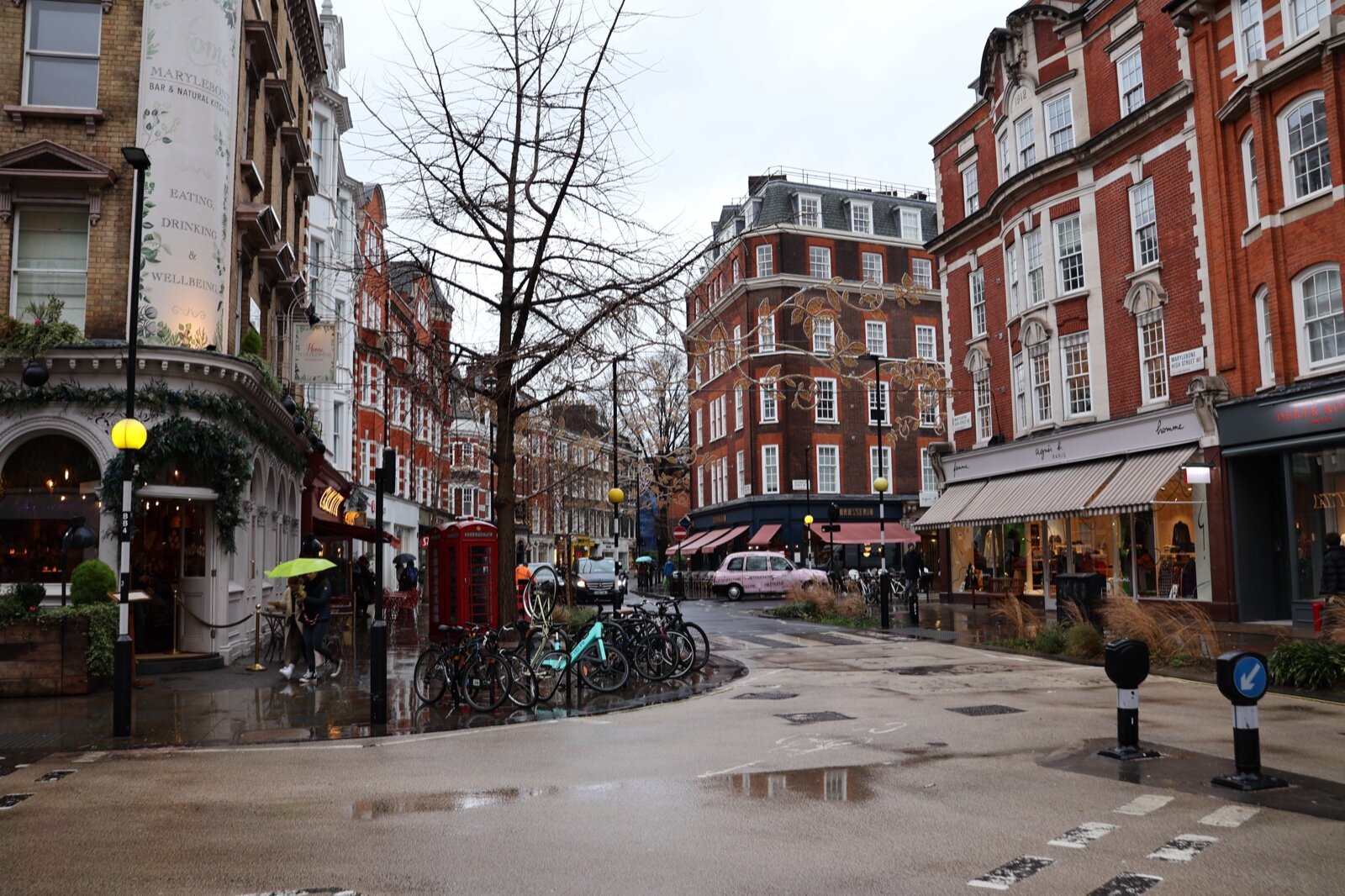
Marylebone High Street. Photo: Marylebone High Street, London (January 2024) 01 by DiscoA340 (CC BY-SA 4.0), via Wikimedia Commons.
Where Marylebone is and what it feels like
Marylebone sits in the north of the W1 postcode, bordered by Oxford Street to the south, Marble Arch and Edgware Road to the west, Regent's Park to the north and Great Portland Street towards the east. Its heart is Marylebone High Street and the little grid of streets known as Marylebone Village. The scale is domestic and Georgian, the pace slower than Oxford Street a block away, and there is a real sense of a lived-in neighbourhood, with residents, cafes and independent shops rather than only flagship stores. That contrast is exactly the appeal.
Shopping and the High Street
Marylebone High Street is the centre of gravity: a gentle curve lined with independent boutiques, homeware shops, delis and cafes. The best-known address is Daunt Books, an Edwardian bookshop with a long oak-galleried room and skylight that is worth stepping into whether or not you buy. Just off the High Street, Chiltern Street has become a style destination in its own right, with fashion boutiques, the fire-station-turned-hotel Chiltern Firehouse and instrument shops. Marylebone Lane winds down towards Oxford Street with more small shops and old-fashioned character.
Art, music and green space
Marylebone's cultural anchor is the Wallace Collection at Manchester Square, a free national museum in a townhouse setting, home to old master paintings including Frans Hals's Laughing Cavalier, along with armour and French furniture. For music, Wigmore Hall on Wigmore Street is one of the world's finest recital venues for chamber music and song. On the northern edge, Regent's Park brings formal gardens, the boating lake and open lawns, with London Zoo at its far side. Green space and world-class culture are both a short walk from the shops.
Eating, drinking and the market
Marylebone is strong on relaxed, quality eating rather than only special-occasion dining. The High Street and its side streets are full of cafes, wine bars, pubs and restaurants, and on Sundays the Marylebone Farmers' Market fills the Cramer Street car park with producers selling bread, cheese, meat and vegetables. It is one of London's better farmers' markets and a good reason to time a visit for a Sunday morning. For where to base yourself, see our guide to where to stay in W1.
History and the Sherlock connection
The area's name comes from the old church of St Mary by the bourne (a stream), and the parish church of St Marylebone on the Marylebone Road is a landmark. Baker Street, on the western side, carries the district's most famous fictional association: 221B Baker Street, the address of Sherlock Holmes, with a museum and statue nearby. The Marylebone Road also runs past Madame Tussauds and towards Regent's Park, tying the neighbourhood to some of London's best-known attractions.
Getting there
Marylebone is easy to reach. Baker Street station on the north serves the Bakerloo, Jubilee, Metropolitan, Circle and Hammersmith & City lines, Bond Street on the south adds the Central, Jubilee and Elizabeth lines, and Regent's Park and Marble Arch stations sit on the edges. Marylebone station itself is a mainline terminus for Chiltern Railways to the north-west. Once you arrive, the area is best explored on foot. For the neighbouring district, read our Mayfair area guide, and for nearby culture see the best museums near Oxford Circus or head back to the W1 London homepage.
Frequently asked questions
What is Marylebone known for?
Marylebone is known for its village feel in the middle of the West End: the elegant Marylebone High Street and Marylebone Village, Daunt Books, the free Wallace Collection, independent shops on Chiltern Street, Regent's Park on its northern edge and Baker Street's Sherlock Holmes associations, all within W1.
Is Marylebone worth visiting?
Yes. Marylebone is one of central London's most pleasant areas to walk, with a genuine neighbourhood atmosphere, good independent shops and cafes, the Wallace Collection and the Sunday farmers' market, and Regent's Park a short stroll away. It is calmer than Oxford Street but only a few minutes from it.
What is there to do in Marylebone?
Browse Daunt Books and the High Street shops, see the free Wallace Collection at Manchester Square, wander Chiltern Street and Marylebone Lane, visit the Sunday farmers' market, walk in Regent's Park, and take in Wigmore Hall for chamber music or Baker Street for the Sherlock Holmes trail.
Which Tube stations serve Marylebone?
Baker Street sits on the north side on the Bakerloo, Jubilee, Metropolitan, Circle and Hammersmith & City lines, Bond Street on the south has the Central, Jubilee and Elizabeth lines, and Regent's Park and Marble Arch are close by. Marylebone station also serves Chiltern Railways to the north-west.
Is Marylebone the same as Mayfair?
No, though they neighbour each other in W1. Mayfair sits south of Oxford Street and is known for luxury retail and grand hotels, while Marylebone lies north of Oxford Street and has a more relaxed, village-like character built around its High Street and Regent's Park.