
Mayfair vs Marylebone: Which W1 Neighbourhood Is Right for You?
Mayfair vs Marylebone is the choice almost everyone moving into W1 ends up making, and it is decided by Oxford Street. South of it, Mayfair: Georgian squares, Mount Street, hotels, galleries and the highest concentration of company-owned property in Britain. North of it, Marylebone: a curving High Street, Harley Street, Regent's Park at the top and a resident population that actually shops locally. They are ten minutes' walk apart and they behave nothing alike.
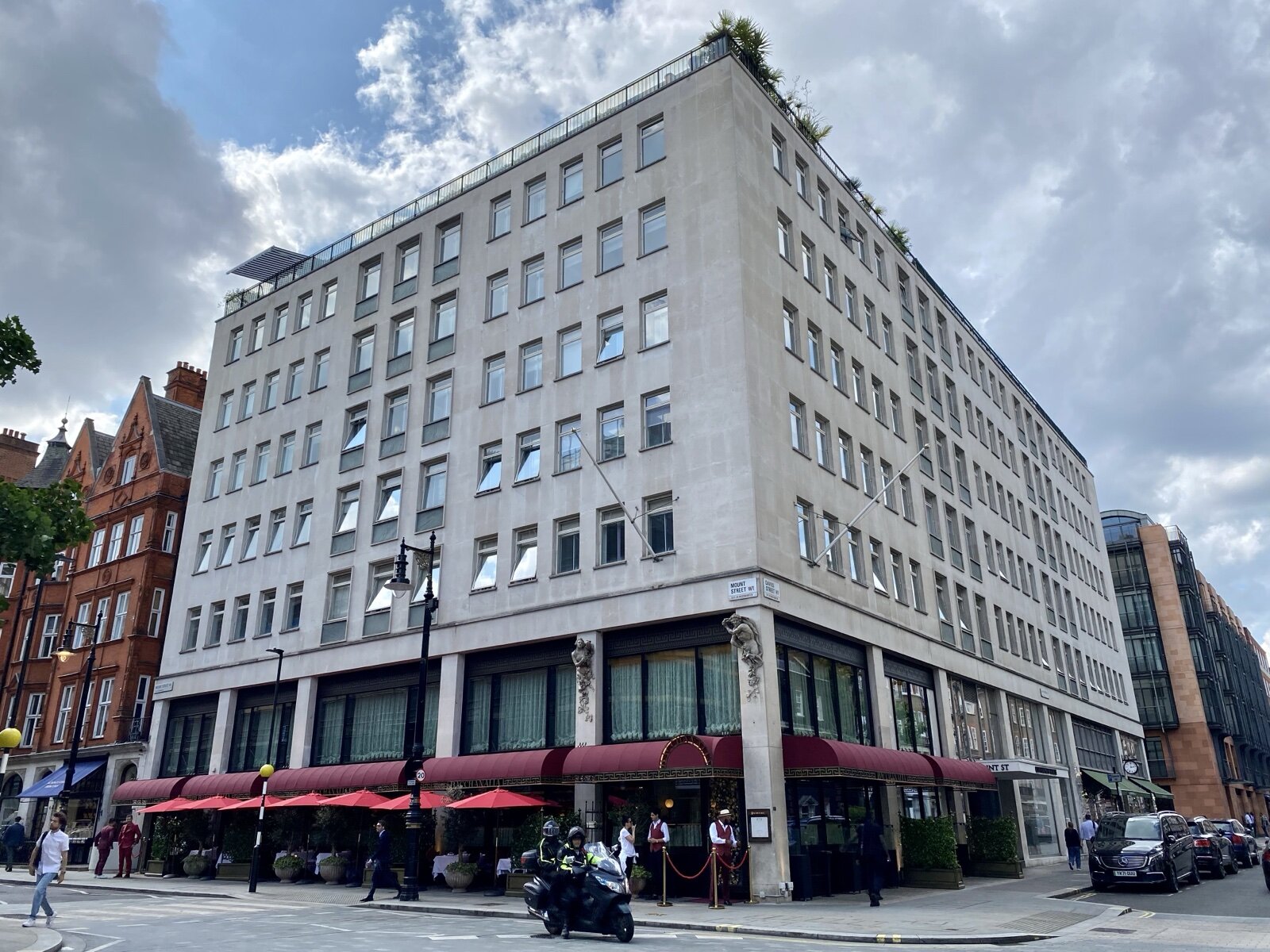
Mount Street at Davies Street, Mayfair. Photo: Connaught House, Mount Street and Davies Street, Mayfair by No Swan So Fine (CC BY-SA 4.0), via Wikimedia Commons.
The price gap, measured
Rather than quote an agent's average, here is what actually changed hands. Taking every standard Land Registry transaction in the City of Westminster registered for sales between 1 August 2025 and 30 June 2026, and splitting by postcode district:
- Mayfair (W1J and W1K): 20 standard sales, median £3,100,000. Flats alone: 18 sales, median £2,975,000. The range ran from £632,000 to £10,300,000, the top sale being a property on Mount Row.
- Marylebone (W1U, W1G and W1H): 103 standard sales, median £1,250,000. Flats alone: 84 sales, median £1,138,750. The range ran from £150,000 to £9,260,000, the top sale on George Street.
Two things in that data are worth more than the headline. First, the volume gap: Marylebone recorded five times as many sales in the same eleven months, in an area that is not five times bigger. Mayfair trades rarely, which is part of why individual prices are so lumpy. Second, the floor: you can still buy in Marylebone under £400,000 in the right block, and Marylebone's cheapest recorded sale was a quarter of Mayfair's.
Two caveats. Land Registry registration lags by roughly two months, so the spring 2026 figures will rise as more sales are recorded. And a 20-sale median is a snapshot, not a valuation.
Character: address versus neighbourhood
Mayfair is the more impressive place to arrive at and the quieter place to live in. Its squares, Grosvenor, Berkeley and Hanover, are surrounded by embassies, private members' clubs, hedge funds and hotels, and a very large share of the residential stock is second homes or corporate. Walk Mount Street on a Tuesday morning and it is one of the most beautiful streets in London. Walk it at half past nine on a Sunday evening and you will pass almost nobody.
Marylebone has the thing Mayfair sold off: daily life. The High Street runs a gentle curve of independents, there is a farmers' market on Sundays behind the Waitrose, the Wallace Collection is free and rarely crowded, and Chiltern Street and Marylebone Lane feel like a village that happens to sit six minutes from Oxford Circus. Our Marylebone area guide covers it street by street, and the Mayfair guide does the same to the south.
Housing stock
- Mayfair. Grand Georgian terraces converted into lateral flats, red-brick Victorian mansion blocks, and a growing number of new luxury schemes behind retained facades. Ceiling heights and floor plates are the selling point. Freehold houses exist and almost never come to market.
- Marylebone. Georgian terraces at a more domestic scale, big interwar mansion blocks around Baker Street and Gloucester Place, and the medical conversions off Harley Street. More one and two bedroom flats, which is why the median is where it is.
Both are overwhelmingly leasehold, and both are dominated by two great estates: Grosvenor in Mayfair and Howard de Walden in Marylebone. That matters more than people expect. Estate landlords control shop tenancy mixes, approve alterations and set lease terms, which is why both areas look coherent and why a licence to alter can be slower than in a fragmented street.
Getting around
- Mayfair: Green Park (Piccadilly, Victoria, Jubilee), Bond Street (Central, Jubilee, Elizabeth), Marble Arch and Hyde Park Corner. Best side for Heathrow.
- Marylebone: Baker Street (Bakerloo, Jubilee, Metropolitan, Circle, Hammersmith and City), Bond Street, Regent's Park, Great Portland Street, plus Marylebone station for Chiltern Railways out to Buckinghamshire and Birmingham.
Parking is difficult and expensive in both; our guide to parking in W1 covers the practicalities.
Green space, schools and everyday things
Marylebone has Regent's Park at the top of the High Street and Paddington Street Gardens in the middle of it. Mayfair has Hyde Park and Green Park on two edges and three garden squares in the middle, most of them private. For families that difference is decisive: Regent's Park has playgrounds, sports pitches and the open-air theatre, and you can walk to it.
Marylebone also keeps the ordinary infrastructure, GP surgeries, a library, a state primary, supermarkets at more than one price point. Mayfair's version of a corner shop is a delicatessen.
Who each one suits
- Choose Mayfair if the address is part of the point, if you want lateral space and hotel-grade service, if you are here part of the year, or if you work in the private-equity and gallery world that lives on those streets.
- Choose Marylebone if you want to live in central London rather than visit it, if you have children or a dog, if you commute north-west by train, or if you want to spend seven figures rather than eight.
If you are weighing the wider postcode first, start with living in W1 and what W1 actually covers.
Frequently Asked Questions
Is Mayfair or Marylebone more expensive?
Mayfair, by a wide margin. Across the 20 standard Land Registry sales recorded in W1J and W1K between 1 August 2025 and 30 June 2026, the median price was £3,100,000. Across the 103 sales in Marylebone's W1U, W1G and W1H over the same period, the median was £1,250,000. Marylebone is not cheap; it is simply less than half Mayfair.
Which is better to live in, Mayfair or Marylebone?
Marylebone, for almost anyone who wants a neighbourhood rather than an address. It has a working High Street, a Sunday farmers' market, a state primary, GPs and a genuine resident population. Mayfair has a far higher proportion of company ownership, second homes and offices, which is what people mean when they say the streets are quiet at night.
What is the difference between Mayfair and Marylebone?
Oxford Street. Mayfair sits south of it, bounded by Park Lane, Piccadilly and Regent Street, and is built around luxury retail, hotels, galleries and hedge funds. Marylebone sits north of it, running up to Regent's Park, and is built around Marylebone High Street, Harley Street medicine and Georgian terraces at a domestic scale.
Is Marylebone a good area to live in London?
Yes, and it is one of the few parts of central London that still functions as a neighbourhood. You get Regent's Park at the top, the Wallace Collection for free, Daunt Books and Chiltern Street, five Tube lines at Baker Street and the Elizabeth line at Bond Street. The trade-offs are price, noise on the Oxford Street edge, and very little outdoor space of your own.
Where exactly does Mayfair end and Marylebone begin?
Oxford Street is the boundary. Postcodes are the practical shorthand: Mayfair is broadly W1J and W1K, with W1S covering the Hanover Square and New Bond Street side; Marylebone is broadly W1U, W1G and W1H, with W1B and W1W on the Fitzrovia edge. Estate agents stretch all of these.
Which has better transport, Mayfair or Marylebone?
It is close, and both are unusually well served. Marylebone has Baker Street with five lines, Bond Street on the Elizabeth line, Marylebone station for Chiltern Railways and Marble Arch at the western end. Mayfair has Green Park, Bond Street and Hyde Park Corner, and is the better side for Heathrow via the Piccadilly line. If you commute out of London by train, Marylebone wins outright.
Sources
- HM Land Registry Price Paid Data, City of Westminster, sales dated 1 August 2025 to 30 June 2026, standard transactions only, analysed by W1 London: landregistry.data.gov.uk
Price Paid figures were pulled on 18 August 2026. Land Registry data lags registration by around two months, so recent months are incomplete.