
Savile Row Tailors: How Bespoke Works, What It Costs and Who to Visit
Savile Row tailors have been cutting suits on one short Mayfair street since the middle of the 19th century, and the street still works the way it did: the pattern is drafted for one customer, the cloth is cut by hand and the suit is fitted several times before it is finished. It is also far more approachable than its reputation. You can walk in, look at cloth and ask questions without committing to anything. This page explains what "Savile Row bespoke" actually means, what a suit costs and how long it takes, which houses are where, and a little of the history on the way.
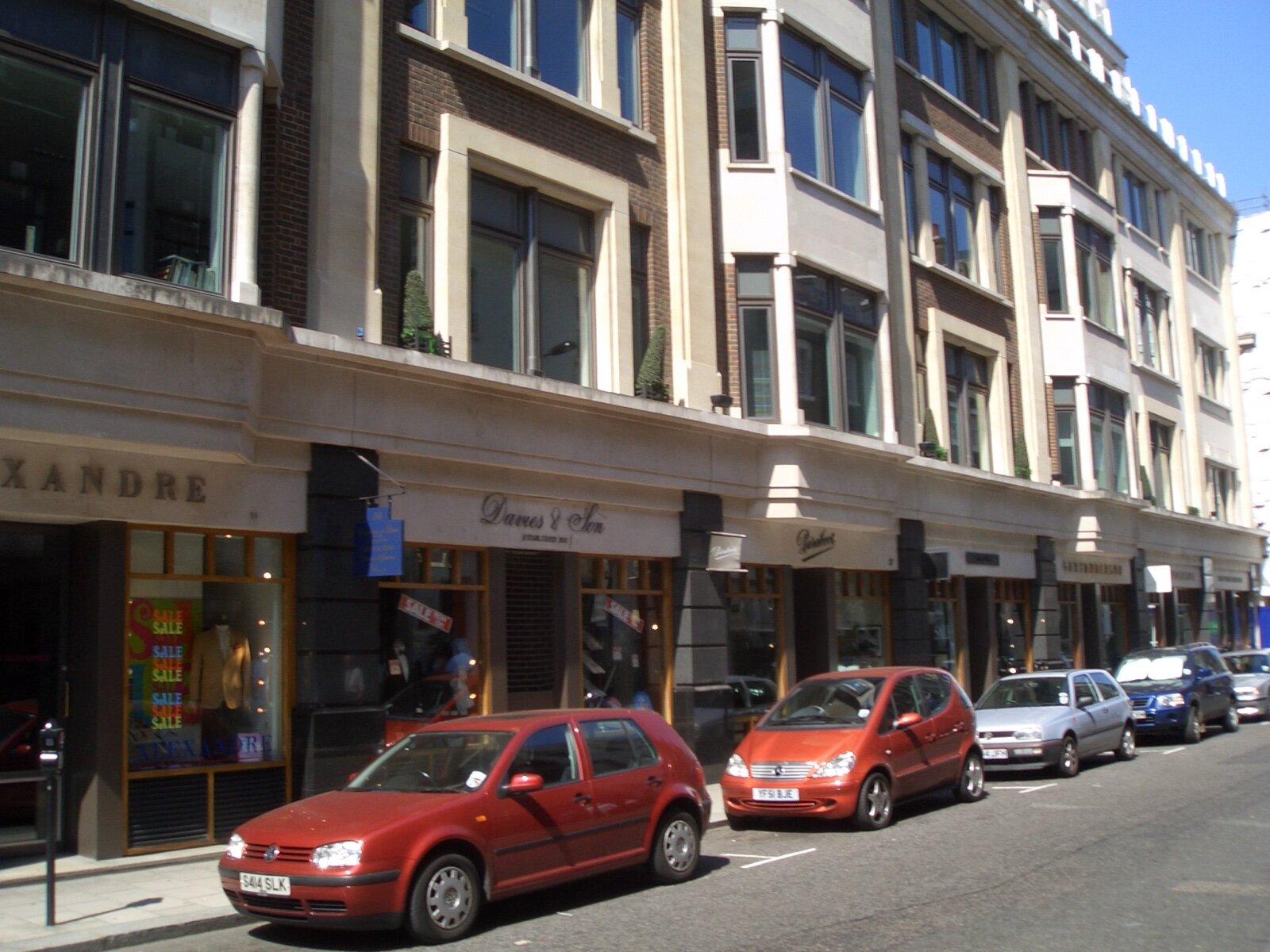

Where: between Burlington Gardens and Conduit Street in Mayfair, W1S, a few minutes' walk from Oxford Circus and Piccadilly Circus.
A bespoke suit: on average about 50 hours of hand work, three intermediate fittings and around three months.
Cost: Huntsman quotes from £7,500 for a two-piece; expect several thousand pounds at any established house.
New for autumn 2026: Gieves & Hawkes reopened its refurbished flagship at No. 1 Savile Row in September.
What "bespoke" means on Savile Row
The word is used loosely elsewhere, so the street set its own definition. The Savile Row Bespoke Association, founded in 2004 by a group of houses including Anderson & Sheppard, Dege & Skinner, Gieves & Hawkes and Henry Poole, now has 22 member and associate member houses. Its standard for a Savile Row bespoke suit is demanding:
- A paper pattern drafted individually for the customer, not adapted from a block.
- An average of fifty hours of work, three intermediate fittings and about three months from order to finished suit.
- Jacket fronts fully hand canvassed, with buttonholes, sleeves and linings sewn by hand.
- Every garment made within a hundred yards of Savile Row, under the eye of a master cutter.
- A choice of at least 2,000 cloths.
Made-to-measure is a different thing: your measurements are applied to an existing pattern and the suit is usually machine-made elsewhere. Several Savile Row houses sell both, and it is worth being clear which one you are being quoted for.
How a commission works
- The first visit. You talk through what the suit is for, choose cloth from the books and are measured by the cutter, who also notes your posture and shape. Expect an hour.
- The baste fitting. A loosely tacked-together version of the suit, often with chalk marks and no finished edges. The cutter pins, marks and sometimes rips it apart to recut.
- The forward fitting. The suit is closer to finished, with sleeves set and pockets cut. Smaller adjustments follow.
- The finish. A final fitting, a last few alterations and collection.
Huntsman, for example, states that each garment goes through a minimum of three fittings. For visitors from abroad, several houses run trunk shows in other cities, so the fittings do not all have to be in London.
What it costs
Bespoke prices are rarely published, and they vary with the cloth. One house that does publish is Huntsman at 11 Savile Row, whose bespoke two-piece suits start from £7,500 for men and women alike, with made-to-measure shirts from £350. Across the established houses, a bespoke two-piece suit is a purchase of several thousand pounds, and heavier cloths, three-piece suits and overcoats cost more. Ask for a quote with the cloth named on it before you commit, and ask what a deposit is and when the balance is due.
The value argument is longevity. A bespoke suit keeps its pattern on file, can be let out or taken in over the years, and is made to be repaired rather than replaced.
Who is where
| House | Address | Known for |
|---|---|---|
| Gieves & Hawkes | 1 Savile Row | Military and naval tailoring since 1771; flagship reopened September 2026 |
| Dege & Skinner | 10 Savile Row | Founded 1865; bespoke tailoring, shirts and military dress, all made at No. 10 |
| Huntsman | 11 Savile Row | A structured, one-button house cut; bespoke from £7,500 |
| Henry Poole & Co | 15 Savile Row | On the Row since 1846, often called its founding house |
| Norton & Sons | 16 Savile Row | Premises renovated and reopened in 2025 |
| Anderson & Sheppard | 32 Old Burlington Street | The soft "English drape" cut; moved off the Row itself in 2005 |
These are only some of the houses; the association's full member list is on its website. Many have a front room you can walk into during opening hours, but for a proper consultation book ahead.
A short history
Savile Row was laid out in the 1730s on the Burlington estate and named after Lady Dorothy Savile, wife of the 3rd Earl of Burlington. For its first century it was a residential street, with military officers and later doctors among its residents. Tailors arrived in the 19th century, following the gentlemen's trade already working in the streets around it. Henry Poole & Co, founded in 1806, moved to Savile Row in 1846, grew into the largest bespoke tailor in the world by 1890 and is widely credited with cutting an early dinner jacket for the Prince of Wales, later Edward VII, in the 1860s.
The street's most famous moment had nothing to do with tailoring. On 30 January 1969 the Beatles played their last live performance on the roof of No. 3, then the offices of their company Apple. It lasted about 42 minutes before the police arrived.
The street has fought off change more than once. In 2012 a plan by Abercrombie & Fitch to open a children's store at No. 3 was met with a protest by well-dressed readers of The Chap magazine, and Westminster City Council has since designated the area a Special Policy Area to protect tailoring uses. A former police station at No. 27 has permission to become a tailoring school run by the London Academy of Bespoke. For more of Mayfair's past, see our blue plaques in Mayfair and Fitzrovia and the oldest places in W1.
Visiting Savile Row
- Getting there: Oxford Circus and Piccadilly Circus stations are each about five to ten minutes' walk away; see getting around W1.
- When: weekdays are best. Most houses keep shop hours and some close at weekends.
- Just looking: tailors are used to visitors. Keep it respectful, do not photograph people at work without asking, and do not expect a tour of the workrooms.
- Nearby: Jermyn Street for shirts and shoes, Burlington Arcade and Bond Street for everything else. Our Mayfair guide covers the wider area, and hidden gems in W1 has quieter corners nearby.
For more on the area, head back to The W1 London homepage.
Frequently Asked Questions
How much is a Savile Row suit?
Prices vary by house and cloth, but a bespoke two-piece suit costs several thousand pounds. Huntsman at 11 Savile Row publishes a starting price of 7,500 pounds for a bespoke two-piece.
How long does a Savile Row bespoke suit take?
The Savile Row Bespoke Association puts it at about three months from order to finished suit, with an average of fifty hours of hand work and three intermediate fittings.
Can you walk into Savile Row tailors?
Yes, most houses have a shop front you can walk into during opening hours to look at cloth and ask questions. For a full consultation and measuring, book an appointment.
What is the difference between bespoke and made-to-measure?
Bespoke means a paper pattern is drafted from scratch for you and the suit is made by hand with several fittings. Made-to-measure adjusts an existing pattern to your measurements and is usually made by machine elsewhere.
Where on Savile Row did the Beatles play?
On the roof of No. 3 Savile Row, then the offices of Apple, on 30 January 1969. It was their last live performance.
Which is the oldest tailor on Savile Row?
Henry Poole and Co, founded in 1806, moved to Savile Row in 1846 and is often called the founding house of the street. Gieves and Hawkes traces its business back further, to 1771, but arrived at No. 1 Savile Row later.