
The Complete Guide to Soho: London's Most Characterful Quarter
One square kilometre with a jazz club that has run since 1959, a market whose founding date is still argued over, four Chinese gates and a garden square laid out in the 1670s. Soho is the part of W1 that rewards walking rather than planning.
Where: bounded by Oxford Street to the north, Shaftesbury Avenue to the south, Regent Street to the west and Charing Cross Road to the east. Postcodes W1D and W1F.
Oldest things still trading: Maison Bertaux, 28 Greek Street, since 1871. Algerian Coffee Stores, 52 Old Compton Street, since 1887. Bar Italia, 22 Frith Street, since 1949.
Ronnie Scott's: 47 Frith Street. Opened on 30 October 1959 in a basement at 39 Gerrard Street, moved to Frith Street in 1965.
Tube: Tottenham Court Road for the east, Piccadilly Circus for the south, Oxford Circus for the north-west. Nothing in Soho is more than about ten minutes from one of them.
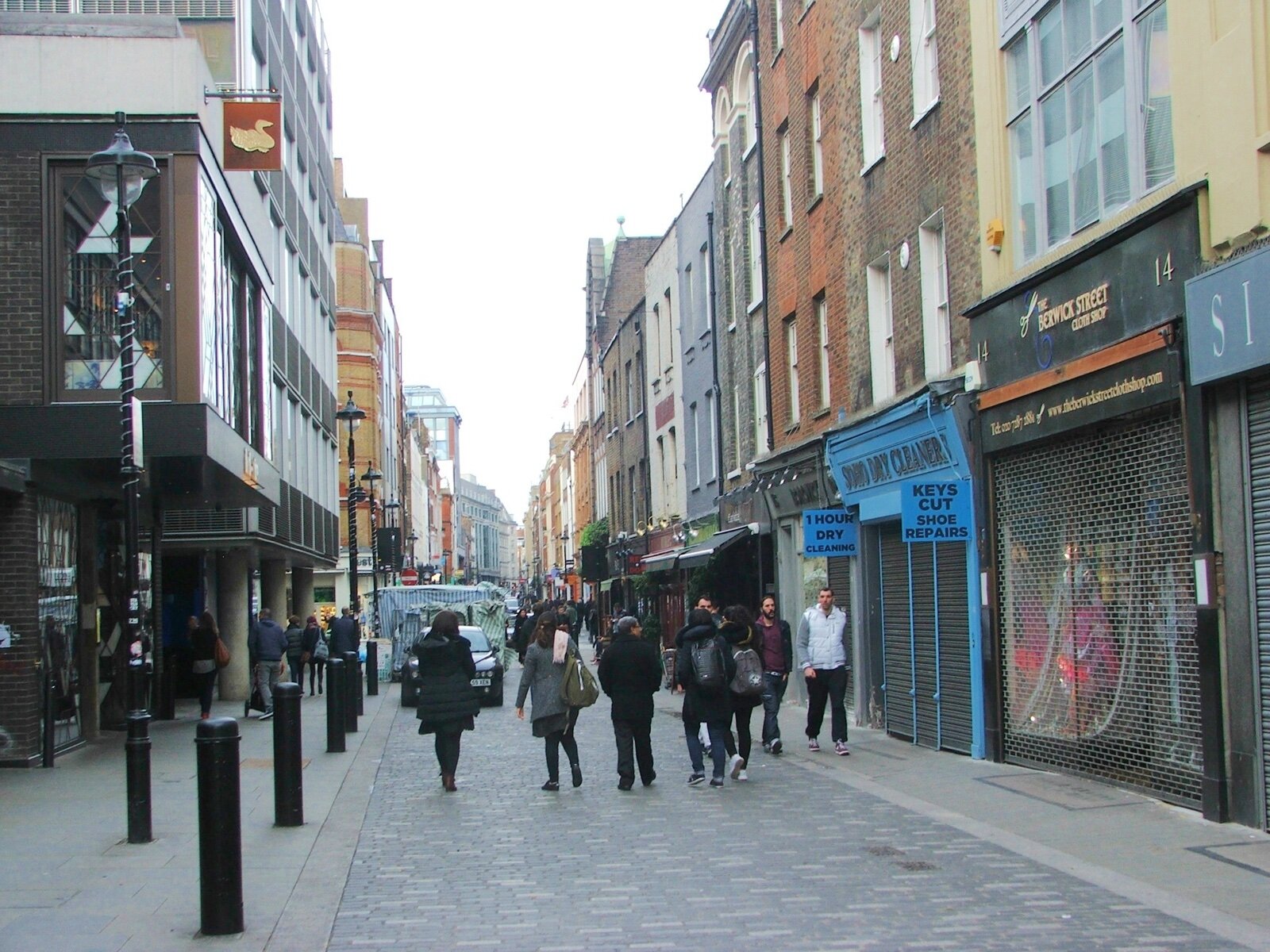
Soho is small. You can walk from Oxford Street to Shaftesbury Avenue in about eight minutes, and from Regent Street to Charing Cross Road in about the same. What makes it feel bigger is density: a theatre, a jazz cellar, a 19th-century patisserie, a members' club and a late-night noodle counter can sit within fifty metres of each other, and the character changes street by street rather than block by block.
This is a guide to what is actually here, with the addresses, and with the claims checked rather than repeated.
Berwick Street, and the date everyone gets wrong
Berwick Street is the spine of central Soho and its market is the oldest continuously commercial thing on it. You will see 1778 quoted widely as the founding date. The documentary record is less certain: a London County Council survey of 1893 put the market's beginning at around 1843, with traders moving in after the construction of Shaftesbury Avenue, and the market does not appear in Henry Mayhew's survey of London street trade. Somewhere between the two is the honest answer.
What is not in doubt is that it still runs, Monday to Saturday, selling fruit and vegetables, flowers, coffee, cheese and a run of hot food stalls that do most of the lunchtime trade. Check current hours before making a special trip, because the street food line-up changes.
The street's other claim on the record is the cover of Oasis's (What's the Story) Morning Glory?, photographed here. The record shops that made Berwick Street a pilgrimage in the 1990s have thinned out, but the street has kept its scale, which is more than can be said for most of the West End.
Soho Square: older than almost everything around it
Soho Square was laid out from 1677, when a development lease for the surrounding fields was granted to the bricklayer Richard Frith, whose name survives on Frith Street. It is the calm room in the building: a lawned garden with benches, open to the public, and free.
The mock-Tudor hut in the middle is not Tudor and never was. It was completed in 1926, designed to look like an octagonal market cross, and it exists to hide an electricity substation. Two Grade II* listed churches face the square, both built in 1891 to 1893: the French Protestant Church at numbers 8 and 9, by Aston Webb, and St Patrick's Roman Catholic church.
The garden as a public space is more recent than the square. It was opened to the public in April 1954, following a lease agreement between the residents and Westminster City Council three years earlier. In summer it hosts free open-air concerts.
Ronnie Scott's and the music streets
Ronnie Scott's opened on 30 October 1959 in a basement at 39 Gerrard Street, set up by the musicians Ronnie Scott and Pete King, and moved to its present home at 47 Frith Street in 1965. It was the first British club to host American jazz musicians regularly, and the list of people who have played it runs from Miles Davis, Nina Simone, Ella Fitzgerald and Chet Baker to Jimi Hendrix and Amy Winehouse.
Practical advice: book. It is a small room, the late show is a different atmosphere from the early one, and walk-up seats are rarely available for a name act.
Around it, Dean Street, Greek Street and Old Compton Street carry the rest of Soho's music and theatre trade, with Shaftesbury Avenue's theatres along the southern edge. Our West End theatre guide covers booking, and the Soho night out questions page deals with timings and door policies.
Chinatown: four gates, two eras
Chinatown occupies the southern strip of Soho around Gerrard Street, which is pedestrianised and lined with restaurants, bakeries and supermarkets. The gates are the visual signature and they come from two distinct periods.
Three paifang-style arches were built between 1985 and 1986, in red with tiled roofs and Chinese calligraphy. The fourth, on Wardour Street, is a different scale altogether: hand-crafted in Beijing, shipped to London and completed in 2016, and the largest Chinese-style gate in the UK.
Eat where the queue is Chinese rather than where the queue is longest. Our Chinatown guide and cheap eats in Soho and Chinatown pages go venue by venue.
The heritage counter trade
Soho's rents have taken out a lot of its independents, which makes the survivors worth using rather than photographing.
- Maison Bertaux, 28 Greek Street, opened in 1871 by a French Communard and generally reckoned the oldest patisserie in London.
- Algerian Coffee Stores, 52 Old Compton Street, founded in 1887 by M. Siari and run by the same family since 1946. It sells beans by weight and espresso to take away, and it is the oldest coffee shop in London.
- Bar Italia, 22 Frith Street, family-run since 1949, open extremely late, and the reason a lot of Soho nights end with a standing espresso rather than a night bus.
Carnaby and the western edge
West Soho, around Carnaby Street and Kingly Court, is the shopping half: pedestrianised, heavily branded, and busiest at weekends. Liberty sits on Great Marlborough Street at the top of it. It is a different Soho from the one east of Wardour Street, and it is the part most visitors see first. Our Oxford Street shopping guide covers the streets immediately north.
A half day that works
- 11.00 Coffee standing up at Bar Italia, 22 Frith Street.
- 11.30 Soho Square, ten minutes on a bench, then the churches on the way out.
- 12.15 Berwick Street market for lunch from a stall.
- 13.30 Carnaby Street and Kingly Court, or Gerrard Street if you would rather have the second lunch.
- 16.00 Beans from Algerian Coffee Stores, cake from Maison Bertaux.
- 19.00 Early show at Ronnie Scott's, booked well in advance, or a Shaftesbury Avenue curtain-up.
How Soho compares with the rest of W1
Mayfair is grander and quieter. Marylebone is the residential one, with a butcher and a Sunday market. Fitzrovia is where the new restaurants open. Soho is the loud one and the late one: it has the highest density of places open after 22.00 in the postcode, the smallest premises, and the fastest turnover of tenants. It is also the only part of W1 where the interesting thing is usually down a staircase rather than behind a doorman.
Frequently Asked Questions
What is Soho known for?
Nightlife, theatre and food in a very small area: Ronnie Scott's jazz club on Frith Street, the Shaftesbury Avenue theatres along its southern edge, Chinatown around Gerrard Street, Berwick Street market, Carnaby Street shopping to the west, and a long history as the centre of London's LGBTQ+ scene around Old Compton Street.
How old is Berwick Street Market?
Older than most London markets, but not as old as the widely quoted 1778. A London County Council survey of 1893 dated the market's start to around 1843, with traders arriving after Shaftesbury Avenue was built, and it does not appear in Henry Mayhew's mid-century survey of London street trade. It still runs Monday to Saturday.
Is Soho Square open to the public?
Yes, and it is free. The garden was opened to the public in April 1954 under an agreement with Westminster City Council. The mock-Tudor hut at its centre was completed in 1926 and conceals an electricity substation. Free open-air concerts run there in summer.
Where is Ronnie Scott's and how do I get in?
47 Frith Street, W1D. Book in advance: it is a small room and walk-up seats for a named act are rare. The club opened on 30 October 1959 at 39 Gerrard Street and moved to Frith Street in 1965.
How many Chinatown gates are there?
Four. Three paifang-style arches were built between 1985 and 1986. The fourth, on Wardour Street, was hand-crafted in Beijing and completed in 2016, and it is the largest Chinese-style gate in the UK.
Which tube station is best for Soho?
It depends which end. Tottenham Court Road for Soho Square, Greek Street and the eastern side, with the Elizabeth line. Piccadilly Circus for Chinatown and the southern edge. Oxford Circus for Carnaby Street and the north-west. Nothing in Soho is more than about ten minutes' walk from one of the three.
Sources
More from The W1 London: the Marylebone guide, Mayfair, Fitzrovia and the best restaurants in Soho.
Addresses and dates checked on 8 September 2026 against each venue's own website and published records. Confirm opening times before travelling.