
Where to Eat in W1: The Complete Guide to Dining in Central London
Deciding where to eat in W1 is less about finding a good restaurant than about narrowing the field. The postcode covers Mayfair, Soho, Marylebone and Fitzrovia, roughly a square mile that holds more restaurants than most British cities, from three-Michelin-star dining rooms on Park Lane to counters in Soho where you queue on the pavement. This guide sorts them the way people actually choose: by which part of W1 you are in, what the meal is for, and what you want to spend.
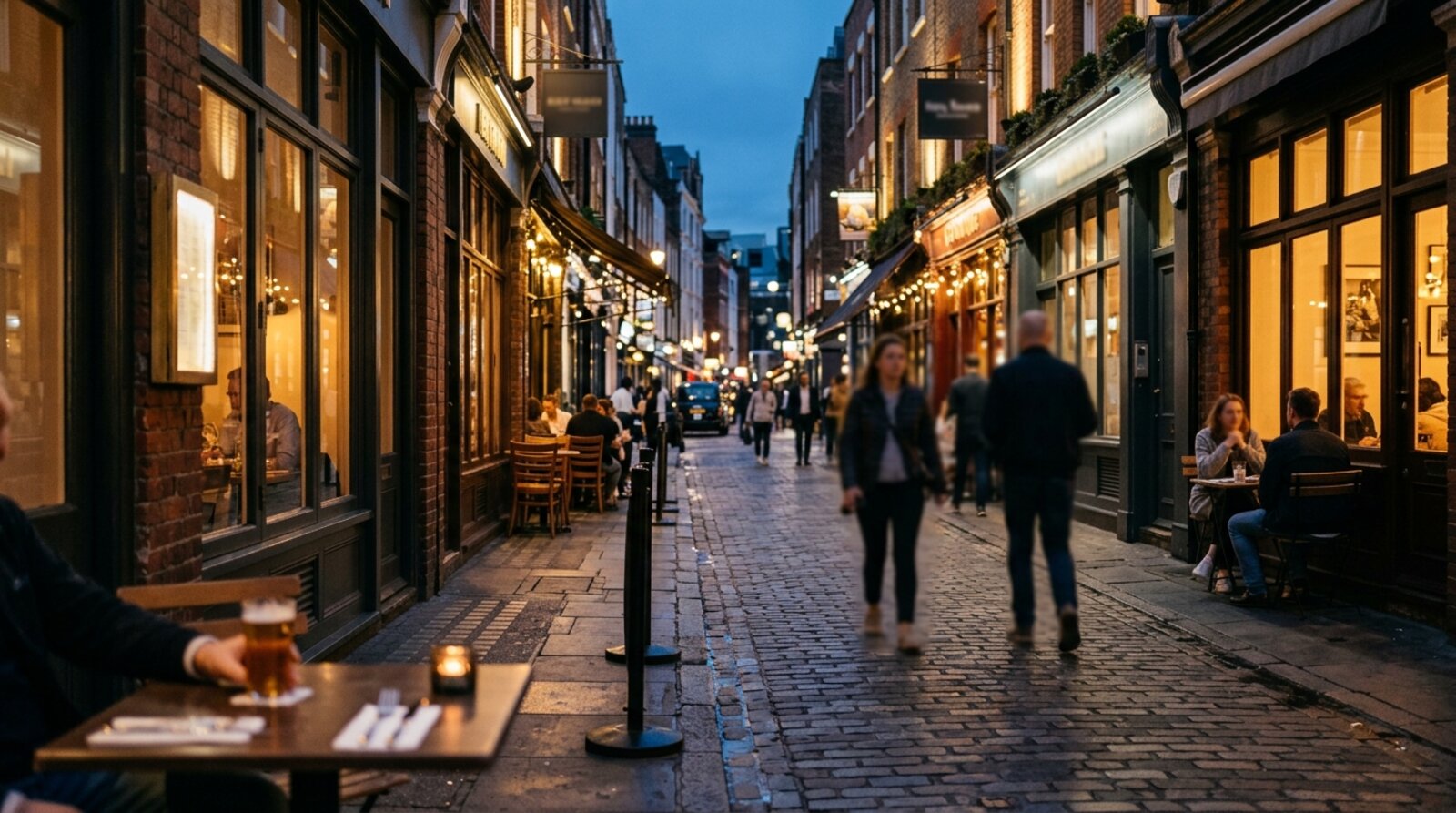
Berwick Street, Soho by Chris Whippet (CC BY-SA 2.0), via Wikimedia Commons.
The four districts, and what each is for
W1 is not one dining scene. Walking ten minutes changes the price, the pace and the reason people are at the table.
- Soho is the densest and the most varied, and it holds nearly all the value. It runs from counters and no-booking rooms up to starred restaurants, often on the same street. If you have not decided what you want, start here.
- Mayfair is the occasion district: hotel dining rooms, long lunches, jackets, and most of W1's Michelin stars. Prices reflect the postcode as much as the plate.
- Marylebone is the calmest. It feels like a neighbourhood rather than a destination, with restaurants that regulars use on a Tuesday, clustered around Marylebone High Street and Blandford Street.
- Fitzrovia sits between the two moods. Charlotte Street and Goodge Street carry a long run of restaurants, and the area is quieter in the evening than Soho a few streets south.
Where to eat in Soho
Soho rewards knowing which street you want. The stretch around Lexington Street, Brewer Street and Berwick Street is where the small, specific kitchens are: Bao on Lexington Street for Taiwanese steamed buns at a counter, Kiln at 58 Brewer Street for Thai grilling over live fire, and Andrew Edmunds at 46 Lexington Street, a candlelit Georgian dining room that has been serving the same kind of unfussy seasonal food for decades. Around the corner on Frith Street, Koya does udon at a wooden counter and Hoppers does Sri Lankan hoppers and short eats.
For something bigger, Blacklock on Great Windmill Street is a chophouse in a former basement club, and Dishoom Carnaby on Kingly Street is the Bombay cafe operation with the longest queue in the district. Brasserie Zedel, in a subterranean art deco hall at 20 Sherwood Street, is the outlier: a full French brasserie at prices that make no sense for the location, including a two-course pre-theatre menu at 16.95 pounds. Prices change, so check before you go, but the principle holds.
Several Soho rooms take no bookings and run a walk-in list. If that is the plan, arrive before 6.30pm or accept a wait with a drink somewhere nearby. Our perfect day in Soho itinerary strings a few of these together, and the Soho night out FAQs cover the practicalities after dinner.
Where to eat in Mayfair
Mayfair is where you go when the meal is the event. It holds three of London's six three-Michelin-star restaurants, all within a few streets of each other, along with a deep bench of one and two-star rooms. The full breakdown is in our guide to Michelin-starred restaurants in W1.
Two things worth knowing before you book. First, set lunch at a starred Mayfair restaurant is often a fraction of the dinner price for the same kitchen, and it is the sensible way in if you are curious rather than committed. Second, not everything in Mayfair is fine dining: Bentley's Oyster Bar & Grill on Swallow Street has been shucking oysters since 1916 and you can eat at the ground-floor bar without a reservation and without a tasting menu.
For the wider area, including the hotels and galleries you might build the day around, see the Mayfair area guide and the best luxury hotels in Mayfair.
Where to eat in Marylebone and Fitzrovia
Marylebone's strength is that it is genuinely residential, so its restaurants are built for repeat visits rather than one-off occasions. Trishna at 15 to 17 Blandford Street is the anchor: coastal Indian cooking, Michelin-starred since 2012, and considerably less formal than that suggests. The streets around Marylebone High Street carry a run of small restaurants, delis and a Sunday farmers' market, and the whole area is quieter on a weekend than anywhere else in W1.
Fitzrovia's spine is Charlotte Street, which has held restaurants continuously for over a century and now runs from long-standing starred kitchens to straightforward neighbourhood places. It is the best part of W1 for a weekday dinner where you want to talk without raising your voice. The Marylebone area guide covers what else is worth your time up there.
By occasion
- Pre-theatre. Fixed-price menus, usually served 5pm to 6.30pm or 7pm, designed to get you to curtain up. Soho and the streets around Shaftesbury Avenue are the natural hunting ground, and Brasserie Zedel is the best-known value option. See the West End theatre guide for what is on.
- A long lunch. Mayfair set lunch, or a Marylebone table on a Saturday. Both give you the room without the evening price.
- Afternoon tea. A category of its own in W1, and one where the hotel matters as much as the food. Our guide to afternoon tea in W1 ranks them.
- Dinner before drinks. Eat early in Soho, then move. Where to go next is covered in where to drink at sunset in W1.
- Eating alone. W1 is unusually good for this because so many of its best rooms are counters. Bao, Koya, Bentley's oyster bar and most sushi counters are all better solo than in a four.
Practical things that change the meal
- Book by day, not by month. A Friday or Saturday in Soho or Mayfair wants two to four weeks of notice, and more with a star attached. A Tuesday at 6pm often has tables the same week.
- Service charge is discretionary. Central London runs at 12.5 to 15 per cent and you can ask for it to come off. Since the Employment (Allocation of Tips) Act came into force on 1 October 2024, employers must pass tips and service charges on to staff in full and fairly, so it now goes where you intend.
- Watch the district lines. Covent Garden, Chinatown's southern half and Piccadilly Circus's south side are WC2 and SW1, not W1. If you are searching by postcode, half the restaurants people call "Soho" are technically over the border.
- Walk it. The whole postcode is about thirty minutes end to end. A cab from Marylebone to Soho at 7pm will usually be slower than walking. If you are driving in, read parking in W1 first, and note the Congestion Charge zone covers all of it.
Start here
If you want one recommendation rather than a map: eat in Soho on a weeknight, early, at a counter, and walk somewhere else for a drink afterwards. It is the cheapest good meal in central London and the version of W1 that people who live here actually use. For the fine-dining end, start with the Michelin list. For the geography, see what the W1 postcode covers, or begin from the W1 London homepage. The official Visit London food and drink guide is a useful second opinion on what has opened recently.
Frequently asked questions
Which part of W1 is best for eating out?
Soho has the highest concentration and the widest price range, so it is the safest choice if you have not decided what you want. Mayfair is for the grand occasion and holds most of the district's Michelin stars. Marylebone is the most relaxed of the four, with neighbourhood restaurants rather than destination ones. Fitzrovia sits between Soho and Marylebone in both geography and character, with a strong run of restaurants along Charlotte Street.
Where can I eat well in W1 without spending a lot?
Soho carries most of the value. Bao on Lexington Street, Koya on Frith Street and Kiln on Brewer Street all serve serious cooking at counter prices, and Brasserie Zedel on Sherwood Street runs a two-course pre-theatre menu at 16.95 pounds. Set lunch menus at smarter restaurants are also far cheaper than the same kitchen at dinner.
How far ahead should I book a restaurant in W1?
For a Friday or Saturday evening in Soho or Mayfair, two to four weeks is sensible, and longer for anything with a Michelin star. Midweek and early evening is a different world: many rooms have space a few days out. Several of the best Soho places take no bookings at all and run a walk-in list, so arriving before 6.30pm is the practical alternative to planning ahead.
What is pre-theatre dining and when is it served?
It is a shortened fixed-price menu aimed at people going on to a West End show, usually served from around 5pm to 6.30pm or 7pm, with the kitchen guaranteeing you are out in time for curtain up. It is the cheapest way to eat at a good W1 restaurant, and the tables go first when a popular show is on.
Do I have to pay the service charge?
Discretionary service charge, usually 12.5 to 15 per cent in central London, is exactly that: discretionary, and you can ask for it to be removed. Since the Employment (Allocation of Tips) Act came into force on 1 October 2024, employers must pass on tips and service charges to staff in full and fairly, so leaving it on now reliably reaches the people who served you.
Which areas does the W1 postcode cover?
W1 covers Mayfair, Soho, Marylebone and Fitzrovia in the West End. It is bounded roughly by Oxford Street to the north, Regent Street through the middle, Park Lane to the west and Charing Cross Road to the east, which makes the whole district walkable end to end in about half an hour.