
Fitzrovia Guide: The Quiet Half of W1
A Fitzrovia guide has to start with what the district is not. It is not Soho, though it shares a border with it, and it is not Bloomsbury, though it borrows the same Georgian street plan. Fitzrovia is the stretch of W1 between Oxford Street and Euston Road, bounded by Tottenham Court Road to the east and Great Portland Street to the west, and it is the only part of the postcode where you can still find a quiet garden square, a free gilded chapel and a pie pub from 1730 within ten minutes of each other.
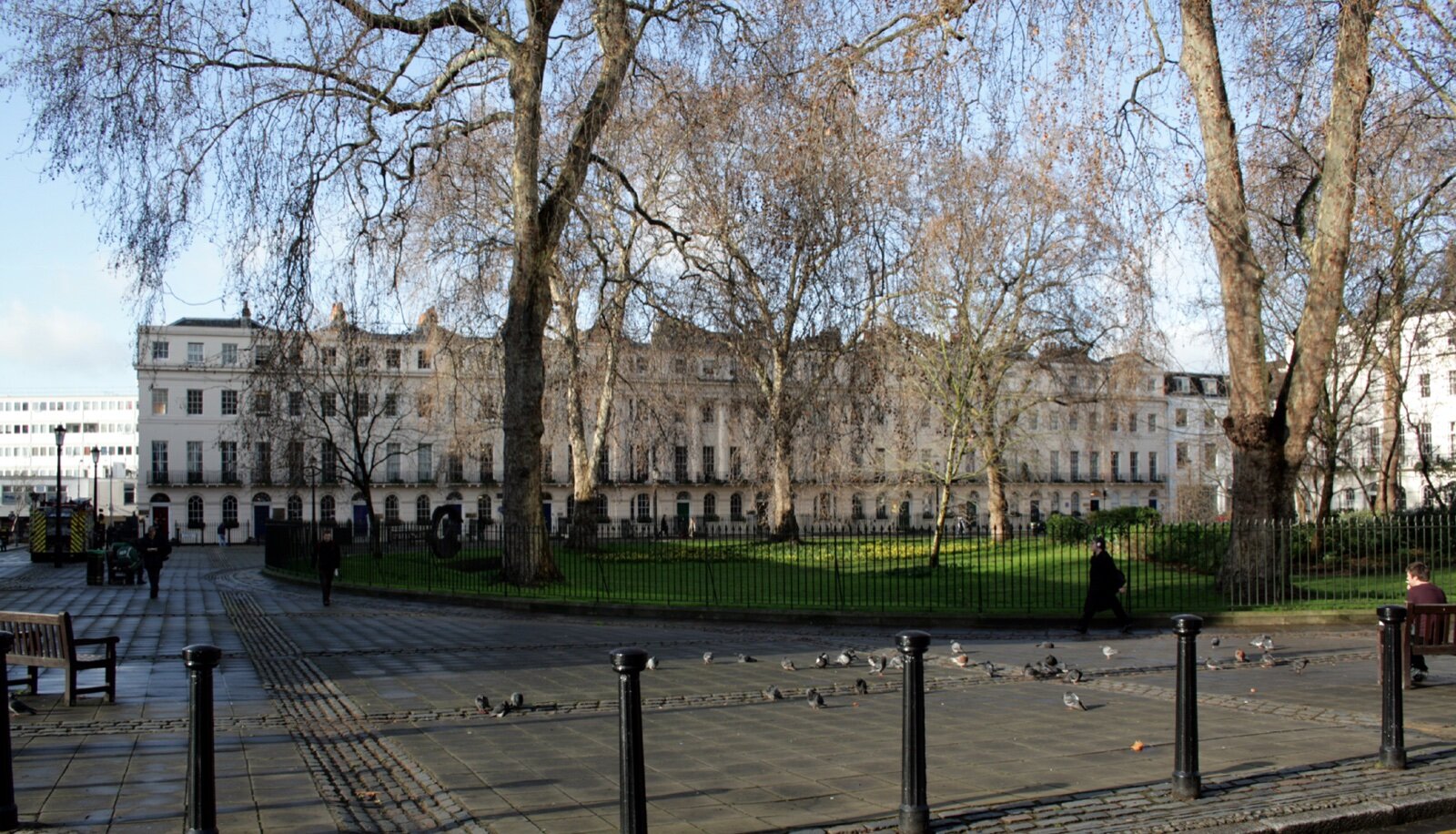
Fitzroy Square, the architectural centre of Fitzrovia. Photo: Fitzroy Square London by User:Mahlum (public domain), via Wikimedia Commons.
The name is younger than the buildings
Fitzrovia is a twentieth-century coinage. The streets are Georgian, laid out by the Fitzroy family from the 1790s, but the district name comes from the Fitzroy Tavern on Charlotte Street and its interwar drinking crowd. The journalist and MP Tom Driberg is generally credited with putting the word into print in the 1940s. That is unusual: a pub that named a neighbourhood rather than the other way round.
Administratively it is still split down the middle. The eastern half sits in the London Borough of Camden and the western half in Westminster, with the boundary running roughly along Cleveland Street. That is why bin collections, parking rules and licensing decisions differ from one side of a street to the other, which matters if you live here. Our guide to living in W1 covers the practicalities.
Fitzroy Square
The architectural set piece, and the reason to walk here rather than through here. The east and south sides were designed by Robert Adam in the 1790s in Portland stone, and the north and west sides were completed later in stucco, which is why the square reads slightly differently depending on which corner you enter from. It is pedestrianised, which is rare in central London and makes it a genuinely calm place to sit.
The blue plaques are worth a slow lap. George Bernard Shaw and Virginia Woolf both lived at number 29, at different times, and the square has housed a long line of artists, writers and, more recently, film production companies. The garden itself is private, but the paved area around it is public and the benches are free.
The Fitzrovia Chapel, free and open three days a week
The single most surprising thing in the district. The Fitzrovia Chapel is all that survives of the Middlesex Hospital, which was demolished in 2008, and it now stands alone in Pearson Square inside the Fitzroy Place development. The interior is entirely covered in gold mosaic, and walking in from a modern square of glass and stone is a genuine shock.
Outside of exhibitions, the chapel is open most Mondays, Tuesdays and Wednesdays from 11am to 5pm, and at least one Sunday each month from noon to 5pm. During exhibitions it is usually open daily. Visiting is always free and you do not need to book, though there is a donation box. It is a small team looking after a historic building, so it does occasionally close for maintenance: check the What's On page before you travel. There are also regular free guided tours and Quiet Days.
If you are collecting free things in central London, this belongs on the same list as the ones in our guide to free things to do in W1 and the museums near Oxford Circus.
Charlotte Street and eating in Fitzrovia
Charlotte Street is the district's restaurant spine and has been for a century. It is dense rather than glamorous, and it fills up properly after 6pm with a mix of media offices emptying out and people who have come specifically to eat. Roka, the Japanese robata grill, is the best-known name on the street, and the surrounding blocks carry an unusually high concentration of independent restaurants for somewhere this central.
The wider point about eating in Fitzrovia is that it is the part of W1 where you can still book a table at short notice. Mayfair requires planning; Fitzrovia frequently does not. Our where to eat in W1 guide covers the whole postcode, and the Michelin-starred restaurants in W1 list shows how the starred rooms cluster elsewhere.
Two pubs worth the walk
The Fitzroy Tavern, on the corner of Charlotte Street and Windmill Street, is the one that named the district. It opened as a coffee house in 1883 and became a pub in 1887, and its reputation was made after 1919 when Judah Morris Kleinfeld took it over and it acquired a bohemian crowd that at various points included George Orwell, Virginia Woolf, George Bernard Shaw and Aleister Crowley. It is a proper pub rather than a museum of itself.
The Newman Arms, at 23 Rathbone Street, calls itself a Fitzrovia institution since 1730 and is built around its pie room. It reopened in October 2025 after a refurbishment. It runs a £20 pie and pint menu, and the useful detail for planning is that it is open Monday to Saturday from noon to 11pm with the pie room serving noon to 3pm and 5pm to 9.30pm, and it is closed on Sundays. Do not plan a Sunday pie here.
For a bigger night, Soho is a five-minute walk south and our best cocktail bars in Soho guide picks up from there.
The BT Tower, and what happens to it
The tower is the thing everyone can see and nobody can get into. It has been closed to the public since the revolving restaurant shut in 1980, and in February 2024 BT Group sold it to the US operator MCR Hotels for £275m. The plan, with Heatherwick Studio as architect, is to convert the Grade II listed tower into a hotel, and the published proposals include a rooftop swimming pool and, more significantly for visitors, opening the top of the tower to the public for the first time in decades.
Do not plan a trip around it. BT still has to decommission and strip out the telecoms equipment inside, a process expected to run to around 2030, and construction follows that. Public consultation events on the proposals were held at UCL. Treat it as a landmark to look at from Cleveland Street, not an attraction.
One thing that has gone
Pollock's Toy Museum, for decades the eccentric highlight of a Fitzrovia afternoon, closed its Scala Street premises in January 2023. The collection did not disappear: Pollock's now operates from Croydon and from Leadenhall Market. But the Fitzrovia building is shut, and older guidebooks and blog posts still send people to Scala Street. Do not be one of them.
Getting here
Fitzrovia is one of the best-connected districts in London and most visitors approach it from the wrong side. Goodge Street and Warren Street on the Northern line put you in the middle of it. Great Portland Street covers the western edge. Tottenham Court Road, on the eastern boundary, is now an Elizabeth line station, which has made the district much quicker to reach from Heathrow, Paddington and the eastern suburbs. Oxford Circus is a five-minute walk from the southern end.
Driving is a bad idea. The district sits inside the Congestion Charge zone, on-street parking is metered and heavily restricted, and the one-way system around Great Portland Street is unforgiving: see parking in W1.
If you are comparing districts before choosing where to stay or where to spend an afternoon, our Mayfair guide and Marylebone area guide cover the other two halves of the postcode, what the W1 postcode actually covers explains the boundaries, and everything else is on the W1 London homepage.
Frequently Asked Questions
Where is Fitzrovia in London?
Fitzrovia sits in the W1 postcode between Oxford Street to the south and Euston Road to the north, with Tottenham Court Road forming its eastern edge and Great Portland Street its western one. It is split administratively between Camden and Westminster, with the boundary running roughly along Cleveland Street. The nearest Underground stations are Goodge Street, Warren Street and Great Portland Street.
Is the Fitzrovia Chapel free to visit?
Yes. Visiting during open days and exhibitions is always free and you do not need to book, though there is a donation box. Outside exhibitions it is open most Mondays, Tuesdays and Wednesdays from 11am to 5pm and at least one Sunday a month from noon to 5pm. It occasionally closes for maintenance, so check the chapel's What's On page before travelling.
Can you go up the BT Tower?
Not at present. The tower has been closed to the public since 1980. MCR Hotels bought it from BT Group for £275m in February 2024 and intends to convert it into a hotel, with plans that include opening the top to the public. BT's decommissioning of the equipment inside is expected to run to around 2030, so any public access is years away.
Why is it called Fitzrovia?
After the Fitzroy Tavern on Charlotte Street, and the bohemian crowd that drank there between the wars. The journalist and MP Tom Driberg is generally credited with popularising the name in print in the 1940s. The street plan itself is older, laid out by the Fitzroy family from the 1790s, and Fitzroy Square carries the same family name.
Is Pollock's Toy Museum still in Fitzrovia?
No. Pollock's closed its Scala Street premises in Fitzrovia in January 2023. The collection now operates from Croydon and from Leadenhall Market. A number of older guides still list the Scala Street address, so check before making a journey.
Is Fitzrovia a good place to eat?
Yes, and it is the part of W1 where you are most likely to get a table at short notice. Charlotte Street has the highest concentration of restaurants and the surrounding streets carry an unusual number of independents for somewhere this central. Roka is the best-known name on Charlotte Street itself.
What is there to do in Fitzrovia?
Walk Fitzroy Square for the Adam terraces and the blue plaques, visit the Fitzrovia Chapel for the gold mosaic interior, eat on Charlotte Street, and drink at the Fitzroy Tavern or the Newman Arms. It is a district for wandering rather than for ticking off attractions, and Soho, Marylebone and the British Museum are all within a fifteen-minute walk.
Sources
- The Fitzrovia Chapel, plan your visit (opening times and admission): fitzroviachapel.org
- The Newman Arms, opening times and address: thenewmanarms.co.uk
- BT Group, announcement of the sale of the BT Tower to MCR Hotels: newsroom.bt.com
Checked on 23 August 2026. Opening hours change; confirm with each venue before travelling.